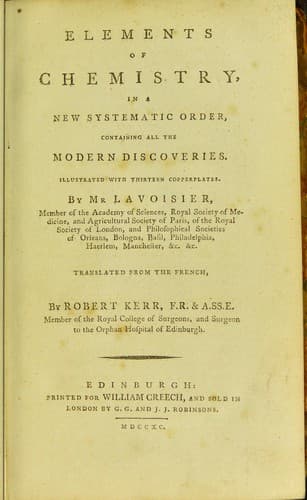
Elements of Chemistry,: In a New Systematic Order, Containing all the Modern DiscoveriesLavoisier, Antoine Laurent
Science
Elements of Chemistry,: In a New Systematic Order, Containing all the Modern Discoveries
Lavoisier, Antoine Laurent
Chemistry -- Early works to 1800
The medium height of mercury in equilibrium with the weight of a column
of air, from the highest part of the atmosphere to the surface of the
earth is about twenty-eight French inches in the lower parts of the city
of Paris; or, in other words, the air at the surface of the earth at
Paris is usually pressed upon by a weight equal to that of a column of
mercury twenty-eight inches in height. I must be understood in this way
in the several parts of this publication when talking of the different
gasses, as, for instance, when the cubical foot of oxygen gas is said to
weigh 1 oz. 4 gros, under 28 inches pressure. The height of this
column of mercury, supported by the pressure of the air, diminishes in
proportion as we are elevated above the surface of the earth, or rather
above the level of the sea, because the mercury can only form an
equilibrium with the column of air which is above it, and is not in the
smallest degree affected by the air which is below its level.
In what ratio does the mercury in the barometer descend in proportion to
its elevation? or, what is the same thing, according to what law or
ratio do the several strata of the atmosphere decrease in density? This
question, which has exercised the ingenuity of natural philosophers
during last century, is considerably elucidated by the following
experiment.
If we take the glass syphon ABCDE, Pl. XII. Fig. 17. shut at E, and open
at A, and introduce a few drops of mercury, so as to intercept the
communication of air between the leg AB and the leg BE, it is evident
that the air contained in BCDE is pressed upon, in common with the whole
surrounding air, by a weight or column of air equal to 28 inches of
mercury. But, if we pour 28 inches of mercury into the leg AB, it is
plain the air in the branch BCDE will now be pressed upon by a weight
equal to twice 28 inches of mercury, or twice the weight of the
atmosphere; and experience shows, that, in this case, the included air,
instead of filling the tube from B to E, only occupies from C to E, or
exactly one half of the space it filled before. If to this first column
of mercury we add two other portions of 28 inches each, in the branch
AB, the air in the branch BCDE will be pressed upon by four times the
weight of the atmosphere, or four times the weight of 28 inches of
mercury, and it will then only fill the space from D to E, or exactly
one quarter of the space it occupied at the commencement of the
experiment. From these experiments, which may be infinitely varied, has
been deduced as a general law of nature, which seems applicable to all
permanently elastic fluids, that they diminish in volume in proportion
to the weights with which they are pressed upon; or, in other words,
"_the volume of all elastic fluids is in the inverse ratio of the weight
by which they are compressed_."
Public-domain text, read in full here on John Shaqi.
Reviews
Reviews
No reviews yet
Be the first to share your thoughts on this work.
Elsewhere in the archive
Join the Discussion
Join the discussion
Sign in to leave a comment or review.
Sign InorCreate an account