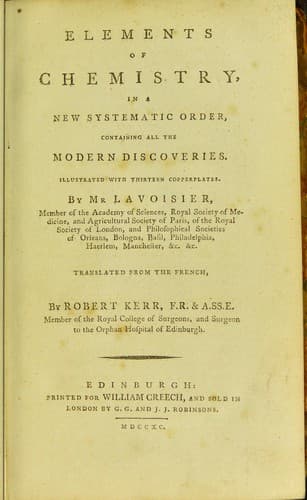
Elements of Chemistry,: In a New Systematic Order, Containing all the Modern DiscoveriesLavoisier, Antoine Laurent
Science
Elements of Chemistry,: In a New Systematic Order, Containing all the Modern Discoveries
Lavoisier, Antoine Laurent
Chemistry -- Early works to 1800
If it is known to contain hydrogen gas, a determinate quantity is
introduced into Volta's eudiometer alongst with a known proportion of
hydrogen gas; these are deflagrated together by means of the electrical
spark; fresh portions of oxygen gas are successively added, till no
farther deflagration takes place, and till the greatest possible
diminution is produced. By this process water is formed, which is
immediately absorbed by the water of the apparatus; but, if the hydrogen
gas contain charcoal, carbonic acid is formed at the same time, which is
not absorbed so quickly; the quantity of this is readily ascertained by
assisting its absorption, by means of agitation. If the residuum
contains nitrous gas, by adding oxygen gas, with which it combines into
nitric acid, we can very nearly ascertain its quantity, from the
diminution produced by this mixture.
I confine myself to these general examples, which are sufficient to give
an idea of this kind of operations; a whole volume would not serve to
explain every possible case. It is necessary to become familiar with the
analysis of gasses by long experience; we must even acknowledge that
they mostly possess such powerful affinities to each other, that we are
not always certain of having separated them completely. In these cases,
we must vary our experiments in every possible point of view, add new
agents to the combination, and keep out others, and continue our trials,
till we are certain of the truth and exactitude of our conclusions.
SECT. V.
_Of the necessary corrections upon the volume of the Gasses, according
to the pressure of the Atmosphere._
All elastic fluids are compressible or condensible in proportion to the
weight with which they are loaded. Perhaps this law, which is
ascertained by general experience, may suffer some irregularity when
these fluids are under a degree of condensation almost sufficient to
reduce them to the liquid state, or when either in a state of extreme
rarefaction or condensation; but we seldom approach either of these
limits with most of the gasses which we submit to our experiments. I
understand this proposition of gasses being compressible, in proportion
to their superincumbent weights, as follows:
A barometer, which is an instrument generally known, is, properly
speaking, a species of syphon, ABCD, Pl. XII. Fig. 16. whose leg AB is
filled with mercury, whilst the leg CD is full of air. If we suppose the
branch CD indefinitely continued till it equals the height of our
atmosphere, we can readily conceive that the barometer is, in reality, a
sort of balance, in which a column of mercury stands in equilibrium
with a column of air of the same weight. But it is unnecessary to
prolongate the branch CD to such a height, as it is evident that the
barometer being immersed in air, the column of mercury AB will be
equally in equilibrium with a column of air of the same diameter, though
the leg CD be cut off at C, and the part CD be taken away altogether.
Public-domain text, read in full here on John Shaqi.
Reviews
Reviews
No reviews yet
Be the first to share your thoughts on this work.
Elsewhere in the archive
Join the Discussion
Join the discussion
Sign in to leave a comment or review.
Sign InorCreate an account