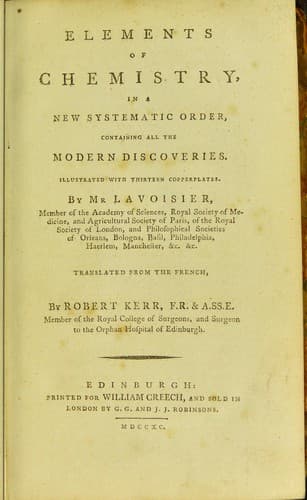
Elements of Chemistry,: In a New Systematic Order, Containing all the Modern DiscoveriesLavoisier, Antoine Laurent
Science
Elements of Chemistry,: In a New Systematic Order, Containing all the Modern Discoveries
Lavoisier, Antoine Laurent
Chemistry -- Early works to 1800
The following case is more complicated: Suppose the jar A, Pl. XII. Fig.
18. to contain a quantity of gas in its upper part ACD, the rest of the
jar below CD being full of mercury, and the whole standing in the
mercurial bason or reservoir GHIK, filled with mercury up to EF, and
that the difference between the surface CD of the mercury in the jar,
and EF, that in the cistern, is six inches, while the barometer stands
at 27.5 inches. It is evident from these data, that the air contained in
ACD is pressed upon by the weight of the atmosphere, diminished by the
weight of the column of mercury CE, or by 27.5 - 6 = 21.5 inches of
barometrical pressure. This air is therefore less compressed than the
atmosphere at the mean height of the barometer, and consequently
occupies more space than it would occupy at the mean pressure, the
difference being exactly proportional to the difference between the
compressing weights. If, then, upon measuring the space ACD, it is found
to be 120 cubical inches, it must be reduced to the volume which it
would occupy under the mean pressure of 28 inches. This is done by the
following statement: 120 : x, the unknown volume, :: 21.5 : 28
inversely; this gives x = 120 x 21.5 / 28 = 92.143 cubical inches.
In these calculations we may either reduce the height of the mercury in
the barometer, and the difference of level in the jar and bason, into
lines or decimal fractions of the inch; but I prefer the latter, as it
is more readily calculated. As, in these operations, which frequently
recur, it is of great use to have means of abbreviation, I have given a
table in the appendix for reducing lines and fractions of lines into
decimal fractions of the inch.
In experiments performed in the water-apparatus, we must make similar
corrections to procure rigorously exact results, by taking into account,
and making allowances for the difference of height of the water within
the jar above the surface of the water in the cistern. But, as the
pressure of the atmosphere is expressed in inches and lines of the
mercurial barometer, and, as homogeneous quantities only can be
calculated together, we must reduce the observed inches and lines of
water into correspondent heights of the mercury. I have given a table in
the appendix for this conversion, upon the supposition that mercury is
13.5681 times heavier than water.
SECT. VI.
_Of Corrections relative to the Degrees of the Thermometer._
Public-domain text, read in full here on John Shaqi.
Reviews
Reviews
No reviews yet
Be the first to share your thoughts on this work.
Elsewhere in the archive
Join the Discussion
Join the discussion
Sign in to leave a comment or review.
Sign InorCreate an account