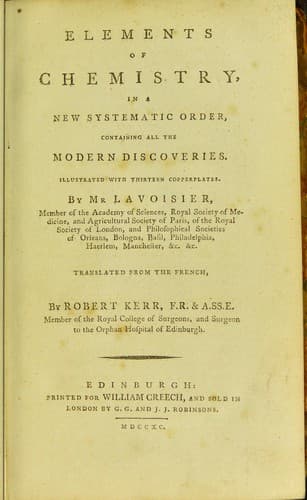
Elements of Chemistry,: In a New Systematic Order, Containing all the Modern DiscoveriesLavoisier, Antoine Laurent
Science
Elements of Chemistry,: In a New Systematic Order, Containing all the Modern Discoveries
Lavoisier, Antoine Laurent
Chemistry -- Early works to 1800
In ascertaining the weight of gasses, besides reducing them to a mean of
barometrical pressure, as directed in the preceding section, we must
likewise reduce them to a standard thermometrical temperature; because,
all elastic fluids being expanded by heat, and condensed by cold, their
weight in any determinate volume is thereby liable to considerable
alterations. As the temperature of 10 deg. (54.5 deg.) is a medium between
the heat of summer and the cold of winter, being the temperature of
subterraneous places, and that which is most easily approached to at all
seasons, I have chosen that degree as a mean to which I reduce air or
gas in this species of calculation.
Mr de Luc found that atmospheric air was increased 1/215 part of its
bulk, by each degree of a mercurial thermometer, divided into 81
degrees, between the freezing and boiling points; this gives 1/211 part
for each degree of Reaumur's thermometer, which is divided into 80
degrees between these two points. The experiments of Mr Monge seem to
make this dilatation less for hydrogen gas, which he thinks is only
dilated 1/180. We have not any exact experiments hitherto published
respecting the ratio of dilatation of the other gasses; but, from the
trials which have been made, their dilatation seems to differ little
from that of atmospheric air. Hence I may take for granted, till farther
experiments give us better information upon this subject, that
atmospherical air is dilated 1/210 part, and hydrogen gas 1/190 part for
each degree of the thermometer; but, as there is still great uncertainty
upon this point, we ought always to operate in a temperature as near as
possible to the standard of 10 deg., (54.5 deg.) by this means any errors
in correcting the weight or volume of gasses by reducing them to the
common standard, will become of little moment.
The calculation for this correction is extremely easy. Divide the
observed volume of air by 210, and multiply the quotient by the degrees
of temperature above or below 10 deg. (54.5 deg.). This correction is
negative when the actual temperature is above the standard, and positive
when below. By the use of logarithmical tables this calculation is much
facilitated[59].
SECT. VII.
_Example for calculating the Corrections relative to the Variations of
Pressure and Temperature._
CASE.
Public-domain text, read in full here on John Shaqi.
Reviews
Reviews
No reviews yet
Be the first to share your thoughts on this work.
Elsewhere in the archive
Join the Discussion
Join the discussion
Sign in to leave a comment or review.
Sign InorCreate an account