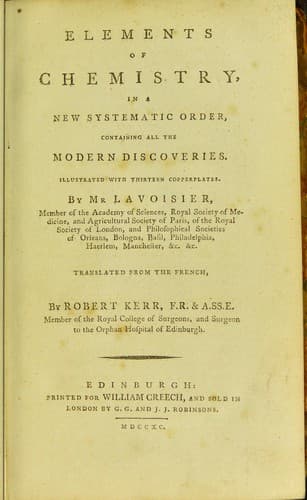
Elements of Chemistry,: In a New Systematic Order, Containing all the Modern DiscoveriesLavoisier, Antoine Laurent
Science
Elements of Chemistry,: In a New Systematic Order, Containing all the Modern Discoveries
Lavoisier, Antoine Laurent
Chemistry -- Early works to 1800
Take a large balloon A, Pl. V. Fig. 10. capable of holding 17 or 18
pints, or about half a cubical foot, having the brass cap bcde
strongly cemented to its neck, and to which the tube and stop-cock f g
is fixed by a tight screw. This apparatus is connected by the double
screw represented separately at Fig. 12. to the jar BCD, Fig. 10. which
must be some pints larger in dimensions than the balloon. This jar is
open at top, and is furnished with the brass cap h i, and stop-cock l
m. One of these slop-cocks is represented separately at Fig. 11.
We first determine the exact capacity of the balloon by filling it with
water, and weighing it both full and empty. When emptied of water, it is
dried with a cloth introduced through its neck d e, and the last
remains of moisture are removed by exhausting it once or twice in an
air-pump.
When the weight of any gas is to be ascertained, this apparatus is used
as follows: Fix the balloon A to the plate of an air-pump by means of
the screw of the stop-cock f g, which is left open; the balloon is to
be exhausted as completely as possible, observing carefully the degree
of exhaustion by means of the barometer attached to the air-pump. When
the vacuum is formed, the stop-cock f g is shut, and the weight of the
balloon determined with the most scrupulous exactitude. It is then fixed
to the jar BCD, which we suppose placed in water in the shelf of the
pneumato chemical apparatus Fig. 1.; the jar is to be filled with the
gas we mean to weigh, and then, by opening the stop-cocks f g and l
m, the gas ascends into the balloon, whilst the water of the cistern
rises at the same time into the jar. To avoid very troublesome
corrections, it is necessary, during this first part of the operation,
to sink the jar in the cistern till the surfaces of the water within the
jar and without exactly correspond. The stop-cocks are again shut, and
the balloon being unscrewed from its connection with the jar, is to be
carefully weighed; the difference between this weight and that of the
exhausted balloon is the precise weight of the air or gas contained in
the balloon. Multiply this weight by 1728, the number of cubical inches
in a cubical foot, and divide the product by the number of cubical
inches contained in the balloon, the quotient is the weight of a cubical
foot of the gas or air submitted to experiment.
Public-domain text, read in full here on John Shaqi.
Reviews
Reviews
No reviews yet
Be the first to share your thoughts on this work.
Elsewhere in the archive
Join the Discussion
Join the discussion
Sign in to leave a comment or review.
Sign InorCreate an account