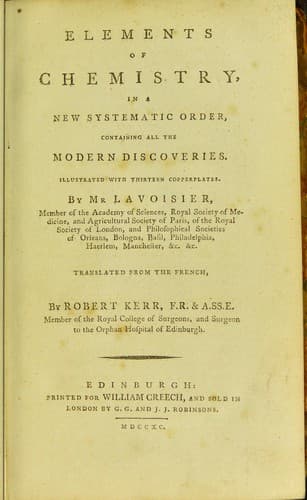
Elements of Chemistry,: In a New Systematic Order, Containing all the Modern DiscoveriesLavoisier, Antoine Laurent
Science
Elements of Chemistry,: In a New Systematic Order, Containing all the Modern Discoveries
Lavoisier, Antoine Laurent
Chemistry -- Early works to 1800
In the jar A, Pl. IV. Fig. 3. standing in a water apparatus, is
contained 353 cubical inches of air; the surface of the water within the
jar at EF is 4-1/2 inches above the water in the cistern, the barometer
is at 27 inches 9-1/2 lines, and the thermometer at 15 deg. (65.75 deg.).
Having burnt a quantity of phosphorus in the air, by which concrete
phosphoric acid is produced, the air after the combustion occupies 295
cubical inches, the water within the jar stands 7 inches above that in
the cistern, the barometer is at 27 inches 9-1/4 lines, and the
thermometer at 16 deg. (68 deg.). It is required from these data to
determine the actual volume of air before and after combustion, and
the quantity absorbed during the process.
_Calculation before Combustion._
The air in the jar before combustion was 353 cubical inches, but it was
only under a barometrical pressure of 27 inches 9-1/2 lines; which,
reduced to decimal fractions by Tab. I. of the Appendix, gives 27.79167
inches; and from this we must deduct the difference of 4-1/2 inches of
water, which, by Tab. II. corresponds to 0.33166 inches of the
barometer; hence the real pressure of the air in the jar is 27.46001. As
the volume of elastic fluids diminish in the inverse ratio of the
compressing weights, we have the following statement to reduce the 353
inches to the volume the air would occupy at 28 inches barometrical
pressure.
353 : x, the unknown volume, :: 27.46001 : 28. Hence, x = 353 x
27.46001 / 28 = 346.192 cubical inches, which is the volume the same
quantity of air would have occupied at 28 inches of the barometer.
The 210th part of this corrected volume is 1.65, which, for the five
degrees of temperature above the standard gives 8.255 cubical inches;
and, as this correction is subtractive, the real corrected volume of the
air before combustion is 337.942 inches.
_Calculation after Combustion._
By a similar calculation upon the volume of air after combustion, we
find its barometrical pressure 27.77083 - 0.51593 = 27.25490. Hence, to
have the volume of air under the pressure of 28 inches, 295 : x ::
27.77083 : 28 inversely; or, x = 295 x 27.25490 / 28 = 287.150. The
210th part of this corrected volume is 1.368, which, multiplied by 6
degrees of thermometrical difference, gives the subtractive correction
for temperature 8.208, leaving the actual corrected volume of air after
combustion 278.942 inches.
_Result._
The corrected volume before combustion 337.942
Ditto remaining after combustion 278.942
--------
Volume absorbed during combustion 59.000.
SECT. VIII.
_Method of determining the Absolute Gravity of the different Gasses._
Public-domain text, read in full here on John Shaqi.
Reviews
Reviews
No reviews yet
Be the first to share your thoughts on this work.
Elsewhere in the archive
Join the Discussion
Join the discussion
Sign in to leave a comment or review.
Sign InorCreate an account