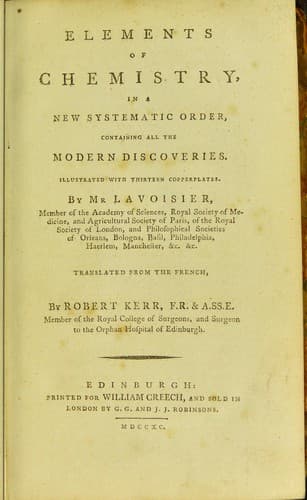
Elements of Chemistry,: In a New Systematic Order, Containing all the Modern DiscoveriesLavoisier, Antoine Laurent
Science
Elements of Chemistry,: In a New Systematic Order, Containing all the Modern Discoveries
Lavoisier, Antoine Laurent
Chemistry -- Early works to 1800
When this machine is to be employed, the middle cavity b b b b, Fig.
2. and 3., the lid GH, Fig. 4. of the interior cavity, the external
cavity a a a a, Fig. 2. and 3. and the general lid FF, Fig. 7. are all
filled with pounded ice, well rammed, so that no void spaces remain, and
the ice of the middle cavity is allowed to drain. The machine is then
opened, and the substance submitted to experiment being placed in the
interior cavity, it is instantly closed. After waiting till the included
body is completely cooled to the freezing point, and the whole melted
ice has drained from the middle cavity, the water collected in the
vessel F, Fig. 1. is accurately weighed. The weight of the water
produced during the experiment is an exact measure of the caloric
disengaged during the cooling of the included body, as this substance is
evidently in a similar situation with the one formerly mentioned as
included in a hollow sphere of ice; the whole caloric disengaged is
stopped by the ice in the middle cavity, and that ice is preserved from
being affected by any other heat by means of the ice contained in the
general lid, Fig. 7. and in the external cavity. Experiments of this
kind last from fifteen to twenty hours; they are sometimes accelerated
by covering up the substance in the interior cavity with well drained
ice, which hastens its cooling.
The substances to be operated upon are placed in the thin iron bucket,
Fig. 8. the cover of which has an opening fitted with a cork, into which
a small thermometer is fixed. When we use acids, or other fluids capable
of injuring the metal of the instruments, they are contained in the
matras, Fig. 10. which has a similar thermometer in a cork fitted to its
mouth, and which stands in the interior cavity upon the small
cylindrical support RS, Fig. 10.
It is absolutely requisite that there be no communication between the
external and middle cavities of the calorimeter, otherwise the ice
melted by the influence of the surrounding air, in the external cavity,
would mix with the water produced from the ice of the middle cavity,
which would no longer be a measure of the caloric lost by the substance
submitted to experiment.
When the temperature of the atmosphere is only a few degrees above the
freezing point, its heat can hardly reach the middle cavity, being
arrested by the ice of the cover, Fig. 7. and of the external cavity;
but, if the temperature of the air be under the degree of freezing, it
might cool the ice contained in the middle cavity, by causing the ice
in the external cavity to fall, in the first place, below zero (32 deg.).
It is therefore essential that this experiment be carried on in a
temperature somewhat above freezing: Hence, in time of frost, the
calorimeter must be kept in an apartment carefully heated. It is
likewise necessary that the ice employed be not under zero (32 deg.); for
which purpose it must be pounded, and spread out thin for some time, in
a place of a higher temperature.
Public-domain text, read in full here on John Shaqi.
Reviews
Reviews
No reviews yet
Be the first to share your thoughts on this work.
Elsewhere in the archive
Join the Discussion
Join the discussion
Sign in to leave a comment or review.
Sign InorCreate an account