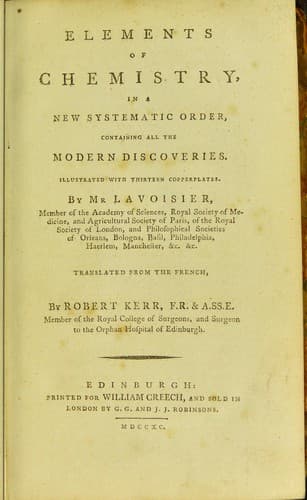
Elements of Chemistry,: In a New Systematic Order, Containing all the Modern DiscoveriesLavoisier, Antoine Laurent
Science
Elements of Chemistry,: In a New Systematic Order, Containing all the Modern Discoveries
Lavoisier, Antoine Laurent
Chemistry -- Early works to 1800
The ice of the interior cavity always retains a certain quantity of
water adhering to its surface, which may be supposed to belong to the
result of the experiment; but as, at the beginning of each experiment,
the ice is already saturated with as much water as it can contain, if
any of the water produced by the caloric should remain attached to the
ice, it is evident, that very nearly an equal quantity of what adhered
to it before the experiment must have run down into the vessel F in its
stead; for the inner surface of the ice in the middle cavity is very
little changed during the experiment.
By any contrivance that could be devised, we could not prevent the
access of the external air into the interior cavity when the atmosphere
was 9 deg. or 10 deg. (52 deg. or 54 deg.) above zero. The air confined
in the cavity being in that case specifically heavier than the external
air, escapes downwards through the pipe x y, Fig. 3, and is replaced by
the warmer external air, which, giving out its caloric to the ice,
becomes heavier, and sinks in its turn; thus a current of air is formed
through the machine, which is the more rapid in proportion as the
external air exceeds the internal in temperature. This current of warm
air must melt a part of the ice, and injure the accuracy of the
experiment: We may, in a great degree, guard against this source of
error by keeping the stop-cock u continually shut; but it is better to
operate only when the temperature of the external air does not exceed
3 deg., or at most 4 deg., (39 deg. to 41 deg.); for we have observed,
that, in this case, the melting of the interior ice by the atmospheric
air is perfectly insensible; so that we may answer for the accuracy of
our experiments upon the specific heat of bodies to a fortieth part.
We have caused make two of the above described machines; one, which is
intended for such experiments as do not require the interior air to be
renewed, is precisely formed according to the description here given;
the other, which answers for experiments upon combustion, respiration,
&c. in which fresh quantities of air are indispensibly necessary,
differs from the former in having two small tubes in the two lids, by
which a current of atmospheric air may be blown into the interior cavity
of the machine.
Public-domain text, read in full here on John Shaqi.
Reviews
Reviews
No reviews yet
Be the first to share your thoughts on this work.
Elsewhere in the archive
Join the Discussion
Join the discussion
Sign in to leave a comment or review.
Sign InorCreate an account