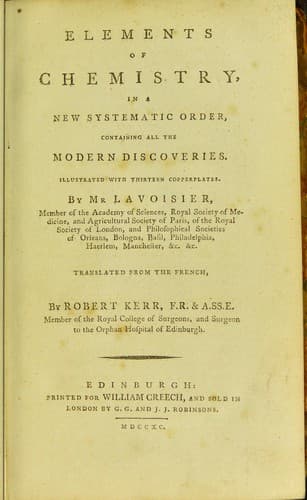
Elements of Chemistry,: In a New Systematic Order, Containing all the Modern DiscoveriesLavoisier, Antoine Laurent
Science
Elements of Chemistry,: In a New Systematic Order, Containing all the Modern Discoveries
Lavoisier, Antoine Laurent
Chemistry -- Early works to 1800
He at first intended to have changed all the weights and measures used
by Mr Lavoisier into their correspondent English denominations, but,
upon trial, the task was found infinitely too great for the time
allowed; and to have executed this part of the work inaccurately, must
have been both useless and misleading to the reader. All that has been
attempted in this way is adding, between brackets ( ), the degrees of
Fahrenheit's scale corresponding with those of Reaumeur's thermometer,
which is used by the Author. Rules are added, however, in the Appendix,
for converting the French weights and measures into English, by which
means the reader may at any time calculate such quantities as occur,
when desirous of comparing Mr Lavoisier's experiments with those of
British authors.
By an oversight, the first part of the translation went to press without
any distinction being preserved between charcoal and its simple
elementary part, which enters into chemical combinations, especially
with oxygen or the acidifying principle, forming carbonic acid. This
pure element, which exists in great plenty in well made charcoal, is
named by Mr Lavoisier _carbone_, and ought to have been so in the
translation; but the attentive reader can very easily rectify the
mistake. There is an error in Plate XI. which the engraver copied
strictly from the original, and which was not discovered until the plate
was worked off at press, when that part of the Elements which treats of
the apparatus there represented came to be translated. The two tubes 21.
and 24. by which the gas is conveyed into the bottles of alkaline
solution 22. 25. should have been made to dip into the liquor, while the
other tubes 23. and 26. which carry off the gas, ought to have been cut
off some way above the surface of the liquor in the bottles.
A few explanatory notes are added; and indeed, from the perspicuity of
the Author, very few were found necessary. In a very small number of
places, the liberty has been taken of throwing to the bottom of the
page, in notes, some parenthetical expressions, only relative to the
subject, which, in their original place, tended to confuse the sense.
These, and the original notes of the Author, are distinguished by the
letter A, and to the few which the Translator has ventured to add, the
letter E is subjoined.
Mr Lavoisier has added, in an Appendix, several very useful Tables for
facilitating the calculations now necessary in the advanced state of
modern chemistry, wherein the most scrupulous accuracy is required. It
is proper to give some account of these, and of the reasons for omitting
several of them.
No. I. of the French Appendix is a Table for converting ounces, gros,
and grains, into the decimal fractions of the French pound; and No. II.
for reducing these decimal fractions again into the vulgar subdivisions.
No. III. contains the number of French cubical inches and decimals which
correspond to a determinate weight of water.
Public-domain text, read in full here on John Shaqi.
Reviews
Reviews
No reviews yet
Be the first to share your thoughts on this work.
Join the Discussion
Join the discussion
Sign in to leave a comment or review.
Sign InorCreate an account