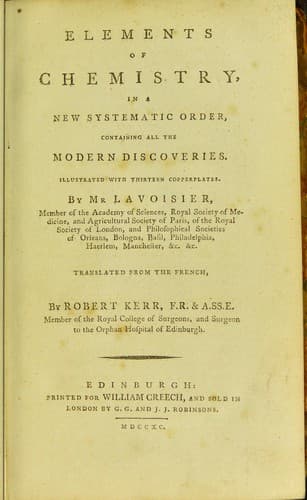
Elements of Chemistry,: In a New Systematic Order, Containing all the Modern DiscoveriesLavoisier, Antoine Laurent
Science
Elements of Chemistry,: In a New Systematic Order, Containing all the Modern Discoveries
Lavoisier, Antoine Laurent
Chemistry -- Early works to 1800
It is somewhat more difficult to determine the specific caloric
contained in the different gasses, on account of their small degree of
density; for, if they are only placed in the calorimeter in vessels like
other fluids, the quantity of ice melted is so small, that the result of
the experiment becomes at best very uncertain. For this species of
experiment we have contrived to make the air pass through two metallic
worms, or spiral tubes; one of these, through which the air passes, and
becomes heated in its way to the calorimeter, is contained in a vessel
full of boiling water, and the other, through which the air circulates
within the calorimeter to disengage its caloric, is placed in the
interior cavity, f f f f, of that machine. By means of a small
thermometer placed at one end of the second worm, the temperature of the
air, as it enters the calorimeter, is determined, and its temperature in
getting out of the interior cavity is found by another thermometer
placed at the other end of the worm. By this contrivance we are enabled
to ascertain the quantity of ice melted by determinate quantities of air
or gas, while losing a certain number of degrees of temperature, and,
consequently, to determine their several degrees of specific caloric.
The same apparatus, with some particular precautions, may be employed
to ascertain the quantity of caloric disengaged by the condensation of
the vapours of different liquids.
The various experiments which may be made with the calorimeter do not
afford absolute conclusions, but only give us the measure of relative
quantities; we have therefore to fix a unit, or standard point, from
whence to form a scale of the several results. The quantity of caloric
necessary to melt a pound of ice has been chosen as this unit; and, as
it requires a pound of water of the temperature of 60 deg. (167 deg.) to
melt a pound of ice, the quantity of caloric expressed by our unit or
standard point is what raises a pound of water from zero (32 deg.) to
60 deg. (167 deg.). When this unit is once determined, we have only to
express the quantities of caloric disengaged from different bodies by
cooling a certain number of degrees, in analogous values: The following
is an easy mode of calculation for this purpose, applied to one of our
earliest experiments.
Public-domain text, read in full here on John Shaqi.
Reviews
Reviews
No reviews yet
Be the first to share your thoughts on this work.
Elsewhere in the archive
Join the Discussion
Join the discussion
Sign in to leave a comment or review.
Sign InorCreate an account