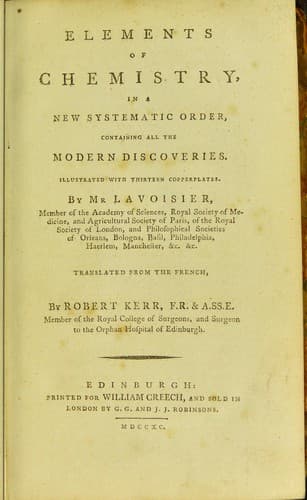
Elements of Chemistry,: In a New Systematic Order, Containing all the Modern DiscoveriesLavoisier, Antoine Laurent
Science
Elements of Chemistry,: In a New Systematic Order, Containing all the Modern Discoveries
Lavoisier, Antoine Laurent
Chemistry -- Early works to 1800
We took 7 lib. 11 oz. 2 gros 36 grs. of plate-iron, cut into
narrow slips, and rolled up, or expressing the quantity in decimals,
7.7070319. These, being heated in a bath of boiling water to about 78 deg.
(207.5 deg.), were quickly introduced into the interior cavity of the
calorimeter: At the end of eleven hours, when the whole quantity of
water melted from the ice had thoroughly drained off, we found that
1.109795 pounds of ice were melted. Hence, the caloric disengaged from
the iron by cooling 78 deg. (175.5 deg.) having melted 1.109795 pounds
of ice, how much would have been melted by cooling 60 deg. (135 deg.)?
This question gives the following statement in direct proportion, 78 :
1.109795 :: 60 : x = 0.85369. Dividing this quantity by the weight of
the whole iron employed, viz. 7.7070319, the quotient 0.110770 is the
quantity of ice which would have been melted by one pound of iron whilst
cooling through 60 deg. (135 deg.) of temperature.
Fluid substances, such as sulphuric and nitric acids, &c. are contained
in a matras, Pl. VI. Fig. 9. having a thermometer adapted to the cork,
with its bulb immersed in the liquid. The matras is placed in a bath of
boiling water, and when, from the thermometer, we judge the liquid is
raised to a proper temperature, the matras is placed in the calorimeter.
The calculation of the products, to determine the specific caloric of
these fluids, is made as above directed, taking care to deduct from the
water obtained the quantity which would have been produced by the matras
alone, which must be ascertained by a previous experiment. The table of
the results obtained by these experiments is omitted, because not yet
sufficiently complete, different circumstances having occasioned the
series to be interrupted; it is not, however, lost sight of; and we are
less or more employed upon the subject every winter.
CHAP. IV.
_Of Mechanical Operations for Division of Bodies._
SECT. I.
_Of Trituration, Levigation, and Pulverization._
These are, properly speaking, only preliminary mechanical operations for
dividing and separating the particles of bodies, and reducing them into
very fine powder. These operations can never reduce substances into
their primary, or elementary and ultimate particles; they do not even
destroy the aggregation of bodies; for every particle, after the most
accurate trituration, forms a small whole, resembling the original mass
from which it was divided. The real chemical operations, on the
contrary, such as solution, destroy the aggregation of bodies, and
separate their constituent and integrant particles from each other.
Public-domain text, read in full here on John Shaqi.
Reviews
Reviews
No reviews yet
Be the first to share your thoughts on this work.
Elsewhere in the archive
Join the Discussion
Join the discussion
Sign in to leave a comment or review.
Sign InorCreate an account