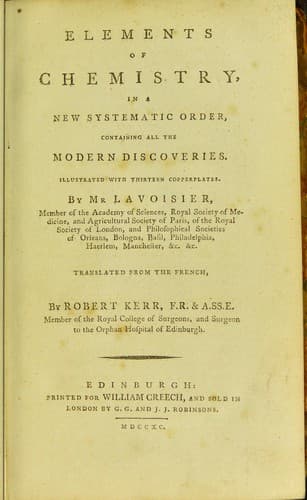
Elements of Chemistry,: In a New Systematic Order, Containing all the Modern DiscoveriesLavoisier, Antoine Laurent
Science
Elements of Chemistry,: In a New Systematic Order, Containing all the Modern Discoveries
Lavoisier, Antoine Laurent
Chemistry -- Early works to 1800
There is a method of procuring powders of an uniform fineness,
considerably more accurate than the sieve; but it can only be used with
such substances as are not acted upon by water. The powdered substance
is mixed and agitated with water, or other convenient fluid; the liquor
is allowed to settle for a few moments, and is then decanted off; the
coarsest powder remains at the bottom of the vessel, and the finer
passes over with the liquid. By repeated decantations in this manner,
various sediments are obtained of different degrees of fineness; the
last sediment, or that which remains longed suspended in the liquor,
being the finest. This process may likewise be used with advantage for
separating substances of different degrees of specific gravity, though
of the same fineness; this last is chiefly employed in mining, for
separating the heavier metallic ores from the lighter earthy matters
with which they are mixed.
In chemical laboratories, pans and jugs of glass or earthen ware are
employed for this operation; sometimes, for decanting the liquor without
disturbing the sediment, the glass syphon ABCHI, Pl. II. Fig. 11. is
used, which may be supported by means of the perforated board DE, at the
proper depth in the vessel FG, to draw off all the liquor required into
the receiver LM. The principles and application of this useful
instrument are so well known as to need no explanation.
SECT. III.
_Of Filtration._
A filtre is a species of very fine sieve, which is permeable to the
particles of fluids, but through which the particles of the finest
powdered solids are incapable of passing; hence its use in separating
fine powders from suspension in fluids. In pharmacy, very close and fine
woollen cloths are chiefly used for this operation; these are commonly
formed in a conical shape, Pl. II. Fig. 2. which has the advantage of
uniting all the liquor which drains through into a point A, where it may
be readily collected in a narrow mouthed vessel. In large pharmaceutical
laboratories, this filtring bag is streached upon a wooden stand, Pl.
II. Fig. 1.
Public-domain text, read in full here on John Shaqi.
Reviews
Reviews
No reviews yet
Be the first to share your thoughts on this work.
Elsewhere in the archive
Join the Discussion
Join the discussion
Sign in to leave a comment or review.
Sign InorCreate an account