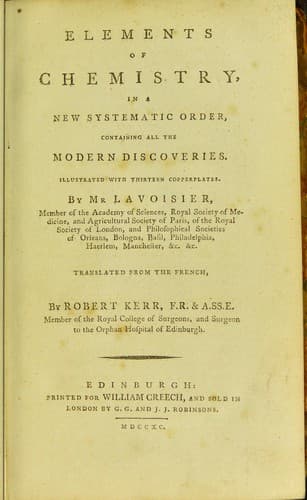
Elements of Chemistry,: In a New Systematic Order, Containing all the Modern DiscoveriesLavoisier, Antoine Laurent
Science
Elements of Chemistry,: In a New Systematic Order, Containing all the Modern Discoveries
Lavoisier, Antoine Laurent
Chemistry -- Early works to 1800
For the purposes of chemistry, as it is requisite to have the filtres
perfectly clean, unsized paper is substituted instead of cloth or
flannel; through this substance, no solid body, however finely it be
powdered, can penetrate, and fluids percolate through it with the
greatest readiness. As paper breaks easily when wet, various methods of
supporting it are used according to circumstances. When a large quantity
of fluid is to be filtrated, the paper is supported by the frame of
wood, Pl. II. Fig. 3. ABCD, having a piece of coarse cloth stretched
over it, by means of iron-hooks. This cloth must be well cleaned each
time it is used, or even new cloth must be employed, if there is reason
to suspect its being impregnated with any thing which can injure the
subsequent operations. In ordinary operations, where moderate quantities
of fluid are to be filtrated, different kinds of glass funnels are used
for supporting the paper, as represented Pl. II. Fig. 5. 6. and 7. When
several filtrations must be carried on at once, the board or shelf AB,
Fig. 9. supported upon stands C and D, and pierced with round holes, is
very convenient for containing the funnels.
Some liquors are so thick and clammy, as not to be able to penetrate
through paper without some previous preparation, such as clarification
by means of white of eggs, which being mixed with the liquor, coagulates
when brought to boil, and, entangling the greater part of the impurities
of the liquor, rises with them to the surface in the state of scum.
Spiritous liquors may be clarified in the same manner by means of
isinglass dissolved in water, which coagulates by the action of the
alkohol without the assistance of heat.
As most of the acids are produced by distillation, and are consequently
clear, we have rarely any occasion to filtrate them; but if, at any
time, concentrated acids require this operation, it is impossible to
employ paper, which would be corroded and destroyed by the acid. For
this purpose, pounded glass, or rather quartz or rock-cristal, broke in
pieces and grossly powdered, answers very well; a few of the larger
pieces are put in the neck of the funnel; these are covered with the
smaller pieces, the finer powder is placed over all, and the acid is
poured on at top. For the ordinary purposes of society, river-water is
frequently filtrated by means of clean washed sand, to separate its
impurities.
SECT. IV.
_Of Decantation._
This operation is often substituted instead of filtration for separating
solid particles which are diffused through liquors. These are allowed to
settle in conical vessels, ABCDE, Pl. II. Fig. 10. the diffused matters
gradually subside, and the clear fluid is gently poured off. If the
sediment be extremely light, and apt to mix again with the fluid by the
slightest motion, the syphon, Fig. 11. is used, instead of decantation,
for drawing off the clear fluid.
Public-domain text, read in full here on John Shaqi.
Reviews
Reviews
No reviews yet
Be the first to share your thoughts on this work.
Elsewhere in the archive
Join the Discussion
Join the discussion
Sign in to leave a comment or review.
Sign InorCreate an account