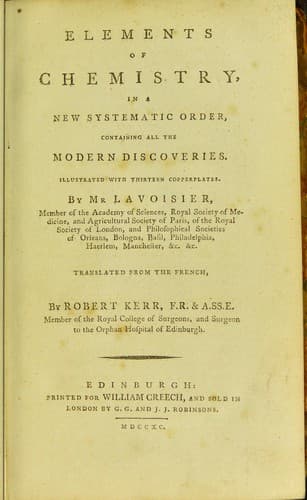
Elements of Chemistry,: In a New Systematic Order, Containing all the Modern DiscoveriesLavoisier, Antoine Laurent
Science
Elements of Chemistry,: In a New Systematic Order, Containing all the Modern Discoveries
Lavoisier, Antoine Laurent
Chemistry -- Early works to 1800
In general, the specific gravity of water is augmented by holding salts
in solution; but there are some exceptions to the rule. Some time hence,
the quantities of radical, of oxygen, and of base, which constitute each
neutral salt, the quantity of water and caloric necessary for solution,
the increased specific gravity communicated to water, and the figure of
the elementary particles of the cristals, will all be accurately known.
From these all the circumstances and phenomena of cristallization will
be explained, and by these means this part of chemistry will be
compleated. Mr Seguin has formed the plan of a thorough investigation of
this kind, which he is extremely capable of executing.
The solution of salts in water requires no particular apparatus; small
glass phials of different sizes, Pl. II. Fig. 16. and 17. pans of
earthern ware, A, Fig. 1. and 2. long-necked matrasses, Fig. 14. and
pans or basons of copper or of silver, Fig. 13. and 15. answer very well
for these operations.
SECT. II.
_Of Lixiviation._
This is an operation used in chemistry and manufactures for separating
substances which are soluble in water from such as are insoluble. The
large vat or tub, Pl. II. Fig. 12. having a hole D near its bottom,
containing a wooden spiget and fosset or metallic stop-cock DE, is
generally used for this purpose. A thin stratum of straw is placed at
the bottom of the tub; over this, the substance to be lixiviated is laid
and covered by a cloth, then hot or cold water, according to the degree
of solubility of the saline matter, is poured on. When the water is
supposed to have dissolved all the saline parts, it is let off by the
stop-cock; and, as some of the water charged with salt necessarily
adheres to the straw and insoluble matters, several fresh quantities of
water are poured on. The straw serves to secure a proper passage for the
water, and may be compared to the straws or glass rods used in
filtrating, to keep the paper from touching the sides of the funnel. The
cloth which is laid over the matters under lixiviation prevents the
water from making a hollow in these substances where it is poured on,
through which it might escape without acting upon the whole mass.
This operation is less or more imitated in chemical experiments; but as
in these, especially with analytical views, greater exactness is
required, particular precautions must be employed, so as not to leave
any saline or soluble part in the residuum. More water must be employed
than in ordinary lixiviations, and the substances ought to be previously
stirred up in the water before the clear liquor is drawn off, otherwise
the whole mass might not be equally lixiviated, and some parts might
even escape altogether from the action of the water. We must likewise
employ fresh portions of water in considerable quantity, until it comes
off entirely free from salt, which we may ascertain by means of the
hydrometer formerly described.
Public-domain text, read in full here on John Shaqi.
Reviews
Reviews
No reviews yet
Be the first to share your thoughts on this work.
Elsewhere in the archive
Join the Discussion
Join the discussion
Sign in to leave a comment or review.
Sign InorCreate an account