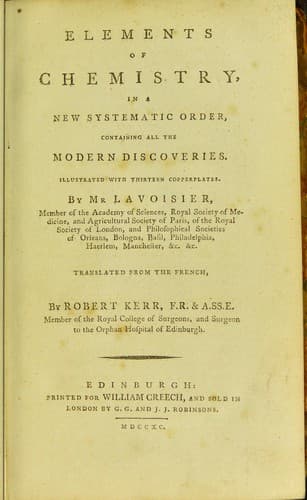
Elements of Chemistry,: In a New Systematic Order, Containing all the Modern DiscoveriesLavoisier, Antoine Laurent
Science
Elements of Chemistry,: In a New Systematic Order, Containing all the Modern Discoveries
Lavoisier, Antoine Laurent
Chemistry -- Early works to 1800
In experiments with small quantities, this operation is conveniently
performed in jugs or matrasses of glass, and by filtrating the liquor
through paper in a glass funnel. When the substance is in larger
quantity, it may be lixiviated in a kettle of boiling water, and
filtrated through paper supported by cloth in the wooden frame, Pl. II.
Fig. 3. and 4.; and in operations in the large way, the tub already
mentioned must be used.
SECT. III.
_Of Evaporation._
This operation is used for separating two substances from each other, of
which one at least must be fluid, and whose degrees of volatility are
considerably different. By this means we obtain a salt, which has been
dissolved in water, in its concrete form; the water, by heating, becomes
combined with caloric, which renders it volatile, while the particles of
the salt being brought nearer to each other, and within the sphere of
their mutual attraction, unite into the solid state.
As it was long thought that the air had great influence upon the
quantity of fluid evaporated, it will be proper to point out the errors
which this opinion has produced. There certainly is a constant slow
evaporation from fluids exposed to the free air; and, though this
species of evaporation may be considered in some degree as a solution in
air, yet caloric has considerable influence in producing it, as is
evident from the refrigeration which always accompanies this process;
hence we may consider this gradual evaporation as a compound solution
made partly in air, and partly in caloric. But the evaporation which
takes place from a fluid kept continually boiling, is quite different in
its nature, and in it the evaporation produced by the action of the air
is exceedingly inconsiderable in comparison with that which is
occasioned by caloric. This latter species may be termed _vaporization_
rather than _evaporation_. This process is not accelerated in proportion
to the extent of evaporating surface, but in proportion to the
quantities of caloric which combine with the fluid. Too free a current
of cold air is often hurtful to this process, as it tends to carry off
caloric from the water, and consequently retards its conversion into
vapour. Hence there is no inconvenience produced by covering, in a
certain degree, the vessels in which liquids are evaporated by continual
boiling, provided the covering body be of such a nature as does not
strongly draw off the caloric, or, to use an expression of Dr
Franklin's, provided it be a bad conductor of heat. In this case, the
vapours escape through such opening as is left, and at least as much is
evaporated, frequently more than when free access is allowed to the
external air.
Public-domain text, read in full here on John Shaqi.
Reviews
Reviews
No reviews yet
Be the first to share your thoughts on this work.
Elsewhere in the archive
Join the Discussion
Join the discussion
Sign in to leave a comment or review.
Sign InorCreate an account