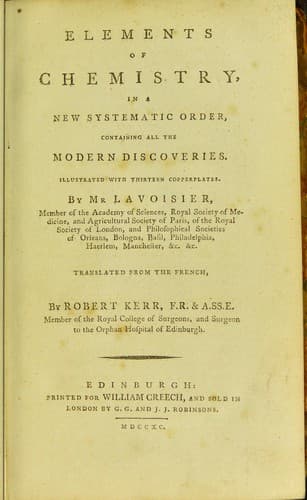
Elements of Chemistry,: In a New Systematic Order, Containing all the Modern DiscoveriesLavoisier, Antoine Laurent
Science
Elements of Chemistry,: In a New Systematic Order, Containing all the Modern Discoveries
Lavoisier, Antoine Laurent
Chemistry -- Early works to 1800
The apparatus I am about to describe is calculated for the most
complicated distillations, and may be simplified according to
circumstances. It consists of a tubulated glass retort A, Pl. IV. Fig.
1. having its beak fitted to a tubulated balloon or recipient BC; to the
upper orifice D of the balloon a bent tube DEfg is adjusted, which, at
its other extremity g, is plunged into the liquor contained in the
bottle L, with three necks xxx. Three other similar bottles are
connected with this first one, by means of three similar bent tubes
disposed in the same manner; and the farthest neck of the last bottle is
connected with a jar in a pneumato-chemical apparatus, by means of a
bent tube[60]. A determinate weight of distilled water is usually put
into the first bottle, and the other three have each a solution of
caustic potash in water. The weight of all these bottles, and of the
water and alkaline solution they contain, must be accurately
ascertained. Every thing being thus disposed, the junctures between the
retort and recipient, and of the tube D of the latter, must be luted
with fat lute, covered over with slips of linen, spread with lime and
white of egg; all the other junctures are to be secured by a lute made
of wax and rosin melted together.
When all these dispositions are completed, and when, by means of heat
applied to the retort A, the substance it contains becomes decomposed,
it is evident that the least volatile products must condense or sublime
in the beak or neck of the retort itself, where most of the concrete
substances will fix themselves. The more volatile substances, as the
lighter oils, ammoniac, and several others, will condense in the
recipient GC, whilst the gasses, which are not susceptible of
condensation by cold, will pass on by the tubes, and boil up through the
liquors in the several bottles. Such as are absorbable by water will
remain in the first bottle, and those which caustic alkali can absorb
will remain in the others; whilst such gasses as are not susceptible of
absorption, either by water or alkalies, will escape by the tube RM, at
the end of which they may be received into jars in a pneumato-chemical
apparatus. The charcoal and fixed earth, &c. which form the substance or
residuum, anciently called _caput mortuum_, remain behind in the retort.
Public-domain text, read in full here on John Shaqi.
Reviews
Reviews
No reviews yet
Be the first to share your thoughts on this work.
Elsewhere in the archive
Join the Discussion
Join the discussion
Sign in to leave a comment or review.
Sign InorCreate an account