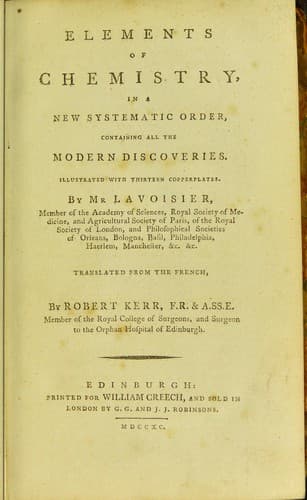
Elements of Chemistry,: In a New Systematic Order, Containing all the Modern DiscoveriesLavoisier, Antoine Laurent
Science
Elements of Chemistry,: In a New Systematic Order, Containing all the Modern Discoveries
Lavoisier, Antoine Laurent
Chemistry -- Early works to 1800
_Of Sublimation._
This term is applied to the distillation of substances which condense in
a concrete or solid form, such as the sublimation of sulphur, and of
muriat of ammoniac, or sal ammoniac. These operations may be
conveniently performed in the ordinary distilling vessels already
described, though, in the sublimation of sulphur, a species of vessels,
named Alludels, have been usually employed. These are vessels of stone
or porcelain ware, which adjust to each other over a cucurbit containing
the sulphur to be sublimed. One of the best subliming vessels, for
substances which are not very volatile, is a flask, or phial of glass,
sunk about two thirds into a sand bath; but in this way we are apt to
lose a part of the products. When these are wished to be entirely
preserved, we must have recourse to the pneumato-chemical distilling
apparatus, to be described in the following chapter.
CHAP. VI.
_Of Pneumato-chemical Distillations, Metallic Dissolutions, and some
other operations which require very complicated instruments._
SECT. I.
_Of Compound and Pneumato-chemical Distillations._
In the preceding chapter, I have only treated of distillation as a
simple operation, by which two substances, differing in degrees of
volatility, may be separated from each other; but distillation often
actually decomposes the substances submitted to its action, and becomes
one of the most complicated operations in chemistry. In every
distillation, the substance distilled must be brought to the state of
gas, in the cucurbit or retort, by combination with caloric: In simple
distillation, this caloric is given out in the refrigeratory or in the
worm, and the substance again recovers its liquid or solid form, but the
substances submitted to compound distillation are absolutely
decompounded; one part, as for instance the charcoal they contain,
remains fixed in the retort, and all the rest of the elements are
reduced to gasses of different kinds. Some of these are susceptible of
being condensed, and of recovering their solid or liquid forms, whilst
others are permanently aeriform; one part of these are absorbable by
water, some by the alkalies, and others are not susceptible of being
absorbed at all. An ordinary distilling apparatus, such as has been
described in the preceding chapter, is quite insufficient for retaining
or for separating these diversified products, and we are obliged to have
recourse, for this purpose, to methods of a more complicated nature.
Public-domain text, read in full here on John Shaqi.
Reviews
Reviews
No reviews yet
Be the first to share your thoughts on this work.
Elsewhere in the archive
Join the Discussion
Join the discussion
Sign in to leave a comment or review.
Sign InorCreate an account