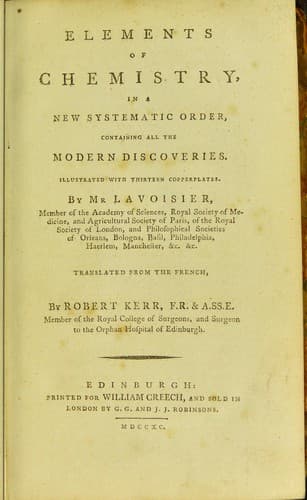
Elements of Chemistry,: In a New Systematic Order, Containing all the Modern DiscoveriesLavoisier, Antoine Laurent
Science
Elements of Chemistry,: In a New Systematic Order, Containing all the Modern Discoveries
Lavoisier, Antoine Laurent
Chemistry -- Early works to 1800
It is evident that, in the course of experiments with this apparatus,
the liquor of the bottles must rise in these tubes in proportion to the
pressure sustained by the gas or air contained in the bottles; and this
pressure is determined by the height and gravity of the column of fluid
contained in all the subsequent bottles. If we suppose that each bottle
contains three inches of fluid, and that there are three inches of water
in the cistern of the connected apparatus above the orifice of the tube
RM, and allowing the gravity of the fluids to be only equal to that of
water, it follows that the air in the first bottle must sustain a
pressure equal to twelve inches of water; the water must therefore rise
twelve inches in the tube S, connected with the first bottle, nine
inches in that belonging to the second, six inches in the third, and
three in the last; wherefore these tubes must be made somewhat more than
twelve, nine, six, and three inches long respectively, allowance being
made for oscillatory motions, which often take place in the liquids. It
is sometimes necessary to introduce a similar tube between the retort
and recipient; and, as the tube is not immersed in fluid at its lower
extremity, until some has collected in the progress of the distillation,
its upper end must be shut at first with a little lute, so as to be
opened according to necessity, or after there is sufficient liquid in
the recipient to secure its lower extremity.
This apparatus cannot be used in very accurate experiments, when the
substances intended to be operated upon have a very rapid action upon
each other, or when one of them can only be introduced in small
successive portions, as in such as produce violent effervescence when
mixed together. In such cases, we employ a tubulated retort A, Pl. VII.
Fig. 1. into which one of the substances is introduced, preferring
always the solid body, if any such is to be treated, we then lute to the
opening of the retort a bent tube BCDA, terminating at its upper
extremity B in a funnel, and at its other end A in a capillary opening.
The fluid material of the experiment is poured into the retort by means
of this funnel, which must be made of such a length, from B to C, that
the column of liquid introduced may counterbalance the resistance
produced by the liquors contained in all the bottles, Pl. IV. Fig. 1.
Public-domain text, read in full here on John Shaqi.
Reviews
Reviews
No reviews yet
Be the first to share your thoughts on this work.
Elsewhere in the archive
Join the Discussion
Join the discussion
Sign in to leave a comment or review.
Sign InorCreate an account