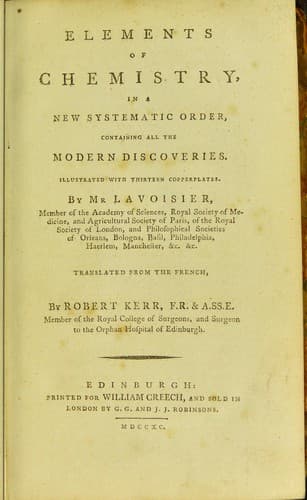
Elements of Chemistry,: In a New Systematic Order, Containing all the Modern DiscoveriesLavoisier, Antoine Laurent
Science
Elements of Chemistry,: In a New Systematic Order, Containing all the Modern Discoveries
Lavoisier, Antoine Laurent
Chemistry -- Early works to 1800
Those who have not been accustomed to use the above described distilling
apparatus may perhaps be startled at the great number of openings which
require luting, and the time necessary for making all the previous
preparations in experiments of this kind. It is very true that, if we
take into account all the necessary weighings of materials and products,
both before and after the experiments, these preparatory and succeeding
steps require much more time and attention than the experiment itself.
But, when the experiment succeeds properly, we are well rewarded for all
the time and trouble bestowed, as by one process carried on in this
accurate manner much more just and extensive knowledge is acquired of
the nature of the vegetable or animal substance thus submitted to
investigation, than by many weeks assiduous labour in the ordinary
method of proceeding.
When in want of bottles with three orifices, those with two may be used;
it is even possible to introduce all the three tubes at one opening, so
as to employ ordinary wide-mouthed bottles, provided the opening be
sufficiently large. In this case we must carefully fit the bottles with
corks very accurately cut, and boiled in a mixture of oil, wax, and
turpentine. These corks are pierced with the necessary holes for
receiving the tubes by means of a round file, as in Pl. IV. Fig. 8.
SECT. II.
_Of Metallic Dissolutions._
I have already pointed out the difference between solution of salts in
water and metallic dissolutions. The former requires no particular
vessels, whereas the latter requires very complicated vessels of late
invention, that we may not lose any of the products of the experiment,
and may thereby procure truly conclusive results of the phenomena which
occur. The metals, in general, dissolve in acids with effervescence,
which is only a motion excited in the solvent by the disengagement of a
great number of bubbles of air or aeriform fluid, which proceed from the
surface of the metal, and break at the surface of the liquid.
Public-domain text, read in full here on John Shaqi.
Reviews
Reviews
No reviews yet
Be the first to share your thoughts on this work.
Elsewhere in the archive
Join the Discussion
Join the discussion
Sign in to leave a comment or review.
Sign InorCreate an account