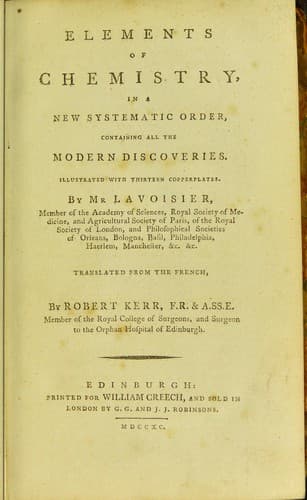
Elements of Chemistry,: In a New Systematic Order, Containing all the Modern DiscoveriesLavoisier, Antoine Laurent
Science
Elements of Chemistry,: In a New Systematic Order, Containing all the Modern Discoveries
Lavoisier, Antoine Laurent
Chemistry -- Early works to 1800
In the vinous fermentation, only carbonic acid gas is disengaged,
carrying with it a small proportion of water in solution. A great part
of this water is deposited in passing through the tube g h i, which is
filled with a deliquescent salt in gross powder, and the quantity is
ascertained by the augmentation of the weight of the salt. The carbonic
acid gas bubbles up through the alkaline solution in the bottle D, to
which it is conveyed by the tube k l m. Any small portion which may
not be absorbed by this first bottle is secured by the solution in the
second bottle E, so that nothing, in general, passes into the jar F,
except the common air contained in the vessels at the commencement of
the experiment.
The same apparatus answers extremely well for experiments upon the
putrefactive fermentation; but, in this case, a considerable quantity of
hydrogen gas is disengaged through the tube q r s t u, by which it is
conveyed into the jar F; and, as this disengagement is very rapid,
especially in summer, the jar must be frequently changed. These
putrefactive fermentations require constant attendance from the above
circumstance, whereas the vinous fermentation hardly needs any. By means
of this apparatus we can ascertain, with great precision, the weights of
the substances submitted to fermentation, and of the liquid and aeriform
products which are disengaged. What has been already said in Part I.
Chap. XIII. upon the products of the vinous fermentation, may be
consulted.
SECT. IV.
_Apparatus for the Decomposition of Water._
Having already given an account, in the first part of this work, of the
experiments relative to the decomposition of water, I shall avoid any
unnecessary repetitions, and only give a few summary observations upon
the subject in this section. The principal substances which have the
power of decomposing water are iron and charcoal; for which purpose,
they require to be made red hot, otherwise the water is only reduced
into vapours, and condenses afterwards by refrigeration, without
sustaining the smallest alteration. In a red heat, on the contrary, iron
or charcoal carry off the oxygen from its union with hydrogen; in the
first case, black oxyd of iron is produced, and the hydrogen is
disengaged pure in form of gas; in the other case, carbonic acid gas is
formed, which disengages, mixed with the hydrogen gas; and this latter
is commonly carbonated, or holds charcoal in solution.
Public-domain text, read in full here on John Shaqi.
Reviews
Reviews
No reviews yet
Be the first to share your thoughts on this work.
Elsewhere in the archive
Join the Discussion
Join the discussion
Sign in to leave a comment or review.
Sign InorCreate an account