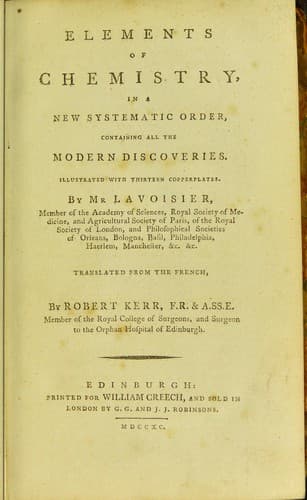
Elements of Chemistry,: In a New Systematic Order, Containing all the Modern DiscoveriesLavoisier, Antoine Laurent
Science
Elements of Chemistry,: In a New Systematic Order, Containing all the Modern Discoveries
Lavoisier, Antoine Laurent
Chemistry -- Early works to 1800
A musket barrel, without its breach pin, answers exceedingly well for
the decomposition of water, by means of iron, and one should be chosen
of considerable length, and pretty strong. When too short, so as to run
the risk of heating the lute too much, a tube of copper is to be
strongly soldered to one end. The barrel is placed in a long furnace,
CDEF, Pl. VII. Fig. 11. so as to have a few degrees of inclination from
E to F; a glass retort A, is luted to the upper extremity E, which
contains water, and is placed upon the furnace VVXX. The lower extremity
F is luted to a worm SS, which is connected with the tubulated bottle H,
in which any water distilled without decomposition, during the
operation, collects, and the disengaged gas is carried by the tube KK to
jars in a pneumato-chemical apparatus. Instead of the retort a funnel
may be employed, having its lower part shut by a stop-cock, through
which the water is allowed to drop gradually into the gun-barrel.
Immediately upon getting into contact with the heated part of the iron,
the water is converted into steam, and the experiment proceeds in the
same manner as if it were furnished in vapours from the retort.
In the experiment made by Mr Meusnier and me before a committee of the
Academy, we used every precaution to obtain the greatest possible
precision in the result of our experiment, having even exhausted all the
vessels employed before we began, so that the hydrogen gas obtained
might be free from any mixture of azotic gas. The results of that
experiment will hereafter be given at large in a particular memoir.
In numerous experiments, we are obliged to use tubes of glass,
porcelain, or copper, instead of gun-barrels; but glass has the
disadvantage of being easily melted and flattened, if the heat be in the
smallest degree raised too high; and porcelain is mostly full of small
minute pores, through which the gas escapes, especially when compressed
by a column of water. For these reasons I procured a tube of brass,
which Mr de la Briche got cast and bored out of the solid for me at
Strasburg, under his own inspection. This tube is extremely convenient
for decomposing alkohol, which resolves into charcoal, carbonic acid
gas, and hydrogen gas; it may likewise be used with the same advantage
for decomposing water by means of charcoal, and in a great number of
experiments of this nature.
FOOTNOTES:
[60] The representation of this apparatus, Pl. IV. Fig. 1. will convey a
much better idea of its disposition than can possibly be given by the
most laboured description.--E.
CHAP. VII.
_Of the Composition and Application of Lutes._
The necessity of properly securing the junctures of chemical vessels to
prevent the escape of any of the products of experiments, must be
sufficiently apparent; for this purpose lutes are employed, which ought
to be of such a nature as to be equally impenetrable to the most subtile
substances, as glass itself, through which only caloric can escape.
Public-domain text, read in full here on John Shaqi.
Reviews
Reviews
No reviews yet
Be the first to share your thoughts on this work.
Elsewhere in the archive
Join the Discussion
Join the discussion
Sign in to leave a comment or review.
Sign InorCreate an account