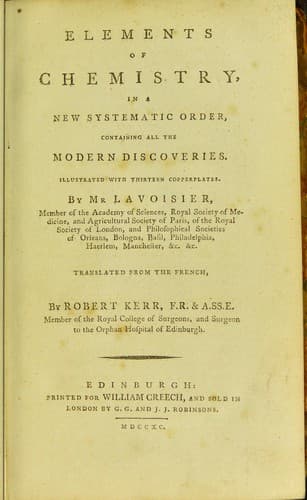
Elements of Chemistry,: In a New Systematic Order, Containing all the Modern DiscoveriesLavoisier, Antoine Laurent
Science
Elements of Chemistry,: In a New Systematic Order, Containing all the Modern Discoveries
Lavoisier, Antoine Laurent
Chemistry -- Early works to 1800
Combustion, according to what has been already said in the First Part of
this Work, is the decomposition of oxygen gas produced by a combustible
body. The oxygen which forms the base of this gas is absorbed by, and
enters into, combination with the burning body, while the caloric and
light are set free. Every combustion, therefore, necessarily supposes
oxygenation; whereas, on the contrary, every oxygenation does not
necessarily imply concomitant combustion; because combustion, properly
so called, cannot take place without disengagement of caloric and light.
Before combustion can take place, it is necessary that the base of
oxygen gas should have greater affinity to the combustible body than it
has to caloric; and this elective attraction, to use Bergman's
expression, can only take place at a certain degree of temperature,
which is different for each combustible substance; hence the necessity
of giving a first motion or beginning to every combustion by the
approach of a heated body. This necessity of heating any body we mean to
burn depends upon certain considerations, which have not hitherto been
attended to by any natural philosopher, for which reason I shall enlarge
a little upon the subject in this place.
Nature is at present in a state of equilibrium, which cannot have been
attained until all the spontaneous combustions or oxygenations possible
in the ordinary degrees of temperature had taken place. Hence, no new
combustions or oxygenations can happen without destroying this
equilibrium, and raising the combustible substances to a superior degree
of temperature. To illustrate this abstract view of the matter by
example: Let us suppose the usual temperature of the earth a little
changed, and that it is raised only to the degree of boiling water; it
is evident, that, in this case, phosphorus, which is combustible in a
considerably lower degree of temperature, would no longer exist in
nature in its pure and simple state, but would always be procured in its
acid or oxygenated state, and its radical would become one of the
substances unknown to chemistry. By gradually increasing the
temperature of the earth the same circumstance would successively happen
to all the bodies capable of combustion; and, at last, every possible
combustion having taken place, there would no longer exist any
combustible body whatever, as every substance susceptible of that
operation would be oxygenated, and consequently incombustible.
Public-domain text, read in full here on John Shaqi.
Reviews
Reviews
No reviews yet
Be the first to share your thoughts on this work.
Elsewhere in the archive
Join the Discussion
Join the discussion
Sign in to leave a comment or review.
Sign InorCreate an account