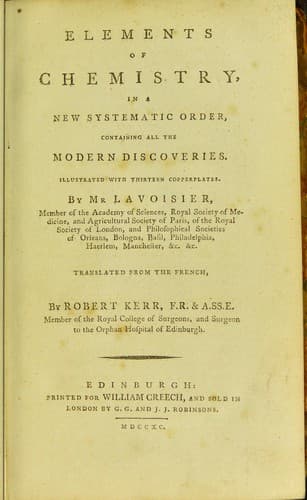
Elements of Chemistry,: In a New Systematic Order, Containing all the Modern DiscoveriesLavoisier, Antoine Laurent
Science
Elements of Chemistry,: In a New Systematic Order, Containing all the Modern Discoveries
Lavoisier, Antoine Laurent
Chemistry -- Early works to 1800
When we have heated a solid body to a certain degree, and have thereby
caused its particles to separate from each other, if we allow the body
to cool, its particles again approach each other in the same proportion
in which they were separated by the increased temperature; the body
returns through the same degrees of expansion which it before extended
through; and, if it be brought back to the same temperature from which
we set out at the commencement of the experiment, it recovers exactly
the same dimensions which it formerly occupied. But, as we are still
very far from being able to arrive at the degree of absolute cold, or
deprivation of all heat, being unacquainted with any degree of coldness
which we cannot suppose capable of still farther augmentation, it
follows, that we are still incapable of causing the ultimate particles
of bodies to approach each other as near as is possible; and,
consequently, that the particles of all bodies do not touch each other
in any state hitherto known, which, tho' a very singular conclusion, is
yet impossible to be denied.
It is supposed, that, since the particles of bodies are thus continually
impelled by heat to separate from each other, they would have no
connection between themselves; and, of consequence, that there could be
no solidity in nature, unless they were held together by some other
power which tends to unite them, and, so to speak, to chain them
together; which power, whatever be its cause, or manner of operation, we
name Attraction.
Thus the particles of all bodies may be considered as subjected to the
action of two opposite powers, the one repulsive, the other attractive,
between which they remain in equilibrio. So long as the attractive force
remains stronger, the body must continue in a state of solidity; but if,
on the contrary, heat has so far removed these particles from each
other, as to place them beyond the sphere of attraction, they lose the
adhesion they before had with each other, and the body ceases to be
solid.
Water gives us a regular and constant example of these facts; whilst
below Zero[2] of the French thermometer, or 32 deg. of Fahrenheit, it
remains solid, and is called ice. Above that degree of temperature, its
particles being no longer held together by reciprocal attraction, it
becomes liquid; and, when we raise its temperature above 80 deg., (212
deg.) its particles, giving way to the repulsion caused by the heat,
assume the state of vapour or gas, and the water is changed into an
aeriform fluid.
The same may be affirmed of all bodies in nature: They are either solid
or liquid, or in the state of elastic aeriform vapour, according to the
proportion which takes place between the attractive force inherent in
their particles, and the repulsive power of the heat acting upon these;
or, what amounts to the same thing, in proportion to the degree of heat
to which they are exposed.
Public-domain text, read in full here on John Shaqi.
Reviews
Reviews
No reviews yet
Be the first to share your thoughts on this work.
Join the Discussion
Join the discussion
Sign in to leave a comment or review.
Sign InorCreate an account