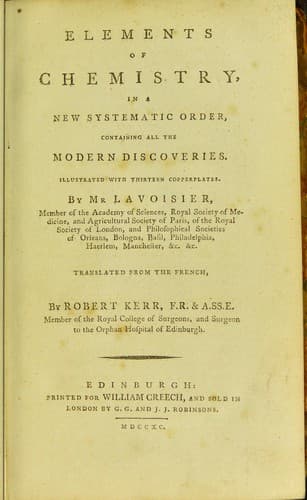
Elements of Chemistry,: In a New Systematic Order, Containing all the Modern DiscoveriesLavoisier, Antoine Laurent
Science
Elements of Chemistry,: In a New Systematic Order, Containing all the Modern Discoveries
Lavoisier, Antoine Laurent
Chemistry -- Early works to 1800
In these combustions we begin by filling a jar, capable at least of
holding six pints, with oxygen gas in the water apparatus, Pl. V. Fig.
1.; when it is perfectly full, so that the gas begins to flow out below,
the jar, A, is carried to the mercury apparatus, Pl. IV. Fig. 3. We then
dry the surface of the mercury, both within and without the jar, by
means of blotting-paper, taking care to keep the paper for some time
entirely immersed in the mercury before it is introduced under the jar,
lest we let in any common air, which sticks very obstinately to the
surface of the paper. The body to be submitted to combustion, being
first very accurately weighed in nice scales, is placed in a small flat
shallow dish, D, of iron or porcelain; this is covered by the larger cup
P, which serves the office of a diving bell, and the whole is passed
through the mercury into the jar, after which the larger cup is retired.
The difficulty of passing the materials of combustion in this manner
through the mercury may be avoided by raising one of the sides of the
jar, A, for a moment, and slipping in the little cup, D, with the
combustible body as quickly as possible. In this manner of operating, a
small quantity of common air gets into the jar, but it is so very
inconsiderable as not to injure either the progress or accuracy of the
experiment in any sensible degree.
When the cup, D, is introduced under the jar, we suck out a part of the
oxygen gas, so as to raise the mercury to EF, as formerly directed, Part
I. Chap. V. otherwise, when the combustible body is set on fire, the gas
becoming dilated would be in part forced out, and we should no longer be
able to make any accurate calculation of the quantities before and after
the experiment. A very convenient mode of drawing out the air is by
means of an air-pump syringe adapted to the syphon, GHI, by which the
mercury may be raised to any degree under twenty-eight inches. Very
inflammable bodies, as phosphorus, are set on fire by means of the
crooked iron wire, MN, Pl. IV. Fig. 16. made red hot, and passed quickly
through the mercury. Such as are less easily set on fire have a small
portion of tinder, upon which a minute particle of phosphorus is fixed,
laid upon them before using the red hot iron.
Public-domain text, read in full here on John Shaqi.
Reviews
Reviews
No reviews yet
Be the first to share your thoughts on this work.
Elsewhere in the archive
Join the Discussion
Join the discussion
Sign in to leave a comment or review.
Sign InorCreate an account