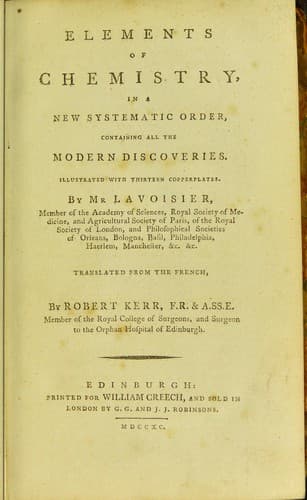
Elements of Chemistry,: In a New Systematic Order, Containing all the Modern DiscoveriesLavoisier, Antoine Laurent
Science
Elements of Chemistry,: In a New Systematic Order, Containing all the Modern Discoveries
Lavoisier, Antoine Laurent
Chemistry -- Early works to 1800
In the first moment of combustion the air, being heated, rarifies, and
the mercury descends; but when, as in combustions of phosphorus and
iron, no elastic fluid is formed, absorption becomes presently very
sensible, and the mercury rises high into the jar. Great attention must
be used not to burn too large a quantity of any substance in a given
quantity of gas, otherwise, towards the end of the experiment, the cup
would approach so near the top of the jar as to endanger breaking it by
the great heat produced, and the sudden refrigeration from the cold
mercury. For the methods of measuring the volume of the gasses, and for
correcting the measures according to the heighth of the barometer and
thermometer, &c. see Chap. II. Sect. V. and VI. of this part.
The above process answers very well for burning all the concrete
substances, and even for the fixed oils: These last are burnt in lamps
under the jar, and are readily set on fire by means of tinder,
phosphorus, and hot iron. But it is dangerous for substances susceptible
of evaporating in a moderate heat, such as ether, alkohol, and the
essential oils; these substances dissolve in considerable quantity in
oxygen gas; and, when set on fire, a dangerous and sudden explosion
takes place, which carries up the jar to a great height, and dashes it
in a thousand pieces. From two such explosions some of the members of
the Academy and myself escaped very narrowly. Besides, though this
manner of operating is sufficient for determining pretty accurately the
quantity of oxygen gas absorbed, and of carbonic acid produced, as water
is likewise formed in all experiments upon vegetable and animal matters
which contain an excess of hydrogen, this apparatus can neither collect
it nor determine its quantity. The experiment with phosphorus is even
incomplete in this way, as it is impossible to demonstrate that the
weight of the phosphoric acid produced is equal to the sum of the
weights of the phosphorus burnt and oxygen gas absorbed during the
process. I have been therefore obliged to vary the instruments according
to circumstances, and to employ several of different kinds, which I
shall describe in their order, beginning with that used for burning
phosphorus.
Public-domain text, read in full here on John Shaqi.
Reviews
Reviews
No reviews yet
Be the first to share your thoughts on this work.
Elsewhere in the archive
Join the Discussion
Join the discussion
Sign in to leave a comment or review.
Sign InorCreate an account