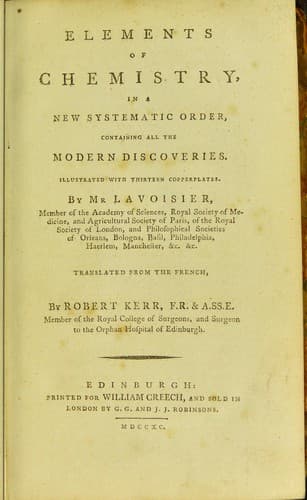
Elements of Chemistry,: In a New Systematic Order, Containing all the Modern DiscoveriesLavoisier, Antoine Laurent
Science
Elements of Chemistry,: In a New Systematic Order, Containing all the Modern Discoveries
Lavoisier, Antoine Laurent
Chemistry -- Early works to 1800
I shall not enter into a more detailed description of the construction
of this apparatus, which is still capable of being altered and modified
in many respects, but shall only add, that when it is to be used in
experiment, the lamp and reservoir with the contained oil must be
accurately weighed, after which it is placed as before directed, and
lighted; having then formed the connection between the air in the
gazometer and the lamp, the external jar A, Pl. XI. is fixed over all,
and secured by means of the board BC and two rods of iron which connect
this board with the lid, and are screwed to it. A small quantity of oil
is burnt while the jar is adjusting to the lid, and the product of that
combustion is lost; there is likewise a small portion of air from the
gazometer lost at the same time. Both of these are of very
inconsiderable consequence in extensive experiments, and they are even
capable of being valued in our calculation of the results.
In a particular memoir, I shall give an account to the Academy of the
difficulties inseparable from this kind of experiments: These are so
insurmountable and troublesome, that I have not hitherto been able to
obtain any rigorous determination of the quantities of the products. I
have sufficient proof, however, that the fixed oils are entirely
resolved during combustion into water and carbonic acid gas, and
consequently that they are composed of hydrogen and charcoal; but I have
no certain knowledge respecting the proportions of these ingredients.
SECT. V.
_Of the Combustion of Alkohol._
The combustion of alkohol may be very readily performed in the apparatus
already described for the combustion of charcoal and phosphorus. A lamp
filled with alkohol is placed under the jar A, Pl. IV. Fig. 3. a small
morsel of phosphorus is placed upon the wick of the lamp, which is set
on fire by means of the hot iron, as before directed. This process is,
however, liable to considerable inconveniency; it is dangerous to make
use of oxygen gas at the beginning of the experiment for fear of
deflagration, which is even liable to happen when common air is
employed. An instance of this had very near proved fatal to myself, in
presence of some members of the Academy. Instead of preparing the
experiment, as usual, at the time it was to be performed, I had disposed
every thing in order the evening before; the atmospheric air of the jar
had thereby sufficient time to dissolve a good deal of the alkohol; and
this evaporation had even been considerably promoted by the height of
the column of mercury, which I had raised to EF, Pl. IV. Fig. 3. The
moment I attempted to set the little morsel of phosphorus on fire by
means of the red hot iron, a violent explosion took place, which threw
the jar with great violence against the floor of the laboratory, and
dashed it in a thousand pieces.
Public-domain text, read in full here on John Shaqi.
Reviews
Reviews
No reviews yet
Be the first to share your thoughts on this work.
Elsewhere in the archive
Join the Discussion
Join the discussion
Sign in to leave a comment or review.
Sign InorCreate an account