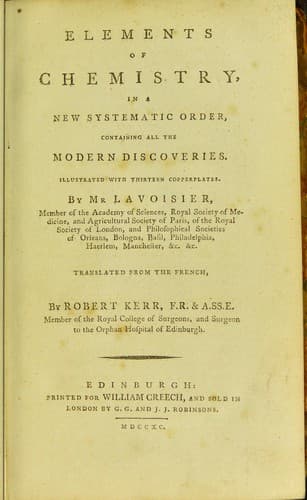
Elements of Chemistry,: In a New Systematic Order, Containing all the Modern DiscoveriesLavoisier, Antoine Laurent
Science
Elements of Chemistry,: In a New Systematic Order, Containing all the Modern Discoveries
Lavoisier, Antoine Laurent
Chemistry -- Early works to 1800
All the metals have not the same degree of affinity to oxygen. Gold,
silver, and platina, for instance, are incapable of taking it away from
its combination with caloric, even in the greatest known heat; whereas
the other metals absorb it in a larger or smaller quantity, until the
affinities of the metal to oxygen, and of the latter to caloric, are in
exact equilibrium. Indeed, this state of equilibrium of affinities may
be assumed as a general law of nature in all combinations.
In all operations of this nature, the oxydation of metals is accelerated
by giving free access to the air; it is sometimes much assisted by
joining the action of a bellows, which directs a stream of air over the
surface of the metal. This process becomes greatly more rapid if a
stream of oxygen gas be used, which is readily done by means of the
gazometer formerly described. The metal, in this case, throws out a
brilliant flame, and the oxydation is very quickly accomplished; but
this method can only be used in very confined experiments, on account of
the expence of procuring oxygen gas. In the essay of ores, and in all
the common operations of the laboratory, the calcination or oxydation of
metals is usually performed in a dish of baked clay, Pl. IV. Fig. 6.
commonly called a _roasting test_, placed in a strong furnace. The
substances to be oxydated are frequently stirred, on purpose to present
fresh surfaces to the air.
Whenever this operation is performed upon a metal which is not volatile,
and from which nothing flies off into the surrounding air during the
process, the metal acquires additional weight; but the cause of this
increased weight during oxydation could never have been discovered by
means of experiments performed in free air; and it is only since these
operations have been performed in close vessels, and in determinate
quantities of air, that any just conjectures have been formed concerning
the cause of this phenomenon. The first method for this purpose is due
to Dr Priestley, who exposes the metal to be calcined in a porcelain cup
N, Pl. IV. Fig. 11. placed upon the stand IK, under a jar A, in the
bason BCDE, full of water; the water is made to rise up to GH, by
sucking out the air with a syphon, and the focus of a burning glass is
made to fall upon the metal. In a few minutes the oxydation takes
place, a part of the oxygen contained in the air combines with the
metal, and a proportional diminution of the volume of air is produced;
what remains is nothing more than azotic gas, still however mixed with a
small quantity of oxygen gas. I have given an account of a series of
experiments made with this apparatus in my Physical and Chemical Essays,
first published in 1773. Mercury may be used instead of water in this
experiment, whereby the results are rendered still more conclusive.
Public-domain text, read in full here on John Shaqi.
Reviews
Reviews
No reviews yet
Be the first to share your thoughts on this work.
Elsewhere in the archive
Join the Discussion
Join the discussion
Sign in to leave a comment or review.
Sign InorCreate an account