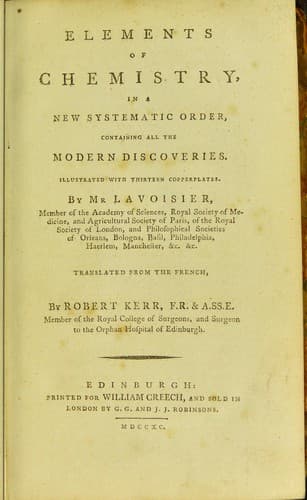
Elements of Chemistry,: In a New Systematic Order, Containing all the Modern DiscoveriesLavoisier, Antoine Laurent
Science
Elements of Chemistry,: In a New Systematic Order, Containing all the Modern Discoveries
Lavoisier, Antoine Laurent
Chemistry -- Early works to 1800
Another process for this purpose was invented by Mr Boyle, and of which
I gave an account in the Memoirs of the Academy for 1774, p. 351. The
metal is introduced into a retort, Pl. III. Fig. 20. the beak of which
is hermetically sealed; the metal is then oxydated by means of heat
applied with great precaution. The weight of the vessel, and its
contained substances, is not at all changed by this process, until the
extremity of the neck of the retort is broken; but, when that is done,
the external air rushes in with a hissing noise. This operation is
attended with danger, unless a part of the air is driven out of the
retort, by means of heat, before it is hermetically sealed, as otherwise
the retort would be apt to burst by the dilation of the air when placed
in the furnace. The quantity of air driven out may be received under a
jar in the pneumato-chemical apparatus, by which its quantity, and that
of the air remaining in the retort, is ascertained. I have not
multiplied my experiments upon oxydation of metals so much as I could
have wished; neither have I obtained satisfactory results with any metal
except tin. It is much to be wished that some person would undertake a
series of experiments upon oxydation of metals in the several gasses;
the subject is important, and would fully repay any trouble which this
kind of experiment might occasion.
As all the oxyds of mercury are capable of revivifying without addition,
and restore the oxygen gas they had before absorbed, this seemed to be
the most proper metal for becoming the subject of conclusive experiments
upon oxydation. I formerly endeavoured to accomplish the oxydation of
mercury in close vessels, by filling a retort, containing a small
quantity of mercury, with oxygen gas, and adapting a bladder half full
of the same gas to its beak; See Pl. IV. Fig. 12. Afterwards, by heating
the mercury in the retort for a very long time, I succeeded in oxydating
a very small portion, so as to form a little red oxyd floating upon the
surface of the running mercury; but the quantity was so small, that the
smallest error committed in the determination of the quantities of
oxygen gas before and after the operation must have thrown very great
uncertainty upon the results of the experiment. I was, besides,
dissatisfied with this process, and not without cause, lest any air
might have escaped through the pores of the bladder, more especially as
it becomes shrivelled by the heat of the furnace, unless covered over
with cloths kept constantly wet.
Public-domain text, read in full here on John Shaqi.
Reviews
Reviews
No reviews yet
Be the first to share your thoughts on this work.
Elsewhere in the archive
Join the Discussion
Join the discussion
Sign in to leave a comment or review.
Sign InorCreate an account