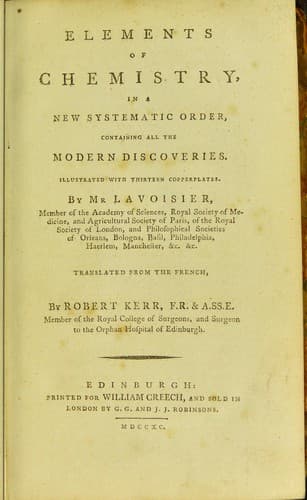
Elements of Chemistry,: In a New Systematic Order, Containing all the Modern DiscoveriesLavoisier, Antoine Laurent
Science
Elements of Chemistry,: In a New Systematic Order, Containing all the Modern Discoveries
Lavoisier, Antoine Laurent
Chemistry -- Early works to 1800
To obtain oxygen gas from the red oxyd of mercury, I usually employ a
porcelain retort, having a long glass tube adapted to its beak, which is
engaged under jars in the water pneumato-chemical apparatus, and I
place a bottle in the water, at the end of the tube, for receiving the
mercury, in proportion as it revives and distils over. As the oxygen gas
never appears till the retort becomes red, it seems to prove the
principle established by Mr Berthollet, that an obscure heat can never
form oxygen gas, and that light is one of its constituent elements. We
must reject the first portion of gas which comes over, as being mixed
with common air, from what was contained in the retort at the beginning
of the experiment; but, even with this precaution, the oxygen gas
procured is usually contaminated with a tenth part of azotic gas, and
with a very small portion of carbonic acid gas. This latter is readily
got rid of, by making the gas pass through a solution of caustic alkali;
but we know of no method for separating the azotic gas; its proportions
may however be ascertained, by leaving a known quantity of the oxygen
gas contaminated with it for a fortnight, in contact with sulphuret of
soda or potash, which absorbs the oxygen gas so as to convert the
sulphur into sulphuric acid, and leaves the azotic gas remaining pure.
We may likewise procure oxygen gas from black oxyd of manganese or
nitrat of potash, by exposing them to a red heat in the apparatus
already described for operating upon red oxyd of mercury; only, as it
requires such a heat as is at least capable of softening glass, we must
employ retorts of stone or of porcelain. But the purest and best oxygen
gas is what is disengaged from oxygenated muriat of potash by simple
heat. This operation is performed in a glass retort, and the gas
obtained is perfectly pure, provided that the first portions, which are
mixed with the common air of the vessels, be rejected.
FOOTNOTES:
[61] See an account of this experiment, Part. I. Chap. iii.--A.
CHAP. IX.
_Of Deflagration._
I have already shown, Part I. Chap. IX. that oxygen does not always part
with the whole of the caloric it contained in the state of gas when it
enters into combination with other bodies. It carries almost the whole
of its caloric alongst with it in entering into the combinations which
form nitric acid and oxygenated muriatic acid; so that in nitrats, and
more especially in oxygenated muriats, the oxygen is, in a certain
degree, in the state of oxygen gas, condensed, and reduced to the
smallest volume it is capable of occupying.
Public-domain text, read in full here on John Shaqi.
Reviews
Reviews
No reviews yet
Be the first to share your thoughts on this work.
Elsewhere in the archive
Join the Discussion
Join the discussion
Sign in to leave a comment or review.
Sign InorCreate an account