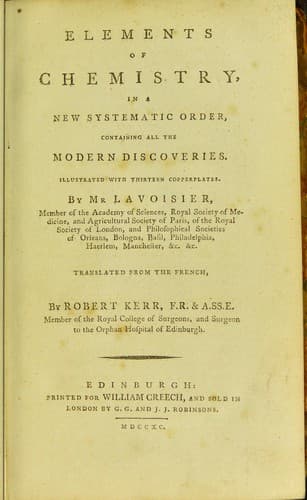
Elements of Chemistry,: In a New Systematic Order, Containing all the Modern DiscoveriesLavoisier, Antoine Laurent
Science
Elements of Chemistry,: In a New Systematic Order, Containing all the Modern Discoveries
Lavoisier, Antoine Laurent
Chemistry -- Early works to 1800
In these combinations, the caloric exerts a constant action upon the
oxygen to bring it back to the state of gas; hence the oxygen adheres
but very slightly, and the smallest additional force is capable of
setting it free; and, when such force is applied, it often recovers the
state of gas instantaneously. This rapid passage from the solid to the
aeriform state is called detonation, or fulmination, because it is
usually accompanied with noise and explosion. Deflagrations are commonly
produced by means of combinations of charcoal either with nitre or
oxygenated muriat of potash; sometimes, to assist the inflammation,
sulphur is added; and, upon the just proportion of these ingredients,
and the proper manipulation of the mixture, depends the art of making
gun-powder.
As oxygen is changed, by deflagration with charcoal, into carbonic acid,
instead of oxygen gas, carbonic acid gas is disengaged, at least when
the mixture has been made in just proportions. In deflagration with
nitre, azotic gas is likewise disengaged, because azote is one of the
constituent elements of nitric acid.
The sudden and instantaneous disengagement and expansion of these gasses
is not, however, sufficient for explaining all the phenomena of
deflagration; because, if this were the sole operating power, gun powder
would always be so much the stronger in proportion as the quantity of
gas disengaged in a given time was the more considerable, which does not
always accord with experiment. I have tried some kinds which produced
almost double the effect of ordinary gun powder, although they gave out
a sixth part less of gas during deflagration. It would appear that the
quantity of caloric disengaged at the moment of detonation contributes
considerably to the expansive effects produced; for, although caloric
penetrates freely through the pores of every body in nature, it can only
do so progressively, and in a given time; hence, when the quantity
disengaged at once is too large to get through the pores of the
surrounding bodies, it must necessarily act in the same way with
ordinary elastic fluids, and overturn every thing that opposes its
passage. This must, at least in part, take place when gun-powder is set
on fire in a cannon; as, although the metal is permeable to caloric, the
quantity disengaged at once is too large to find its way through the
pores of the metal, it must therefore make an effort to escape on every
side; and, as the resistance all around, excepting towards the muzzle,
is too great to be overcome, this effort is employed for expelling the
bullet.
The caloric produces a second effect, by means of the repulsive force
exerted between its particles; it causes the gasses, disengaged at the
moment of deflagration, to expand with a degree of force proportioned to
the temperature produced.
Public-domain text, read in full here on John Shaqi.
Reviews
Reviews
No reviews yet
Be the first to share your thoughts on this work.
Elsewhere in the archive
Join the Discussion
Join the discussion
Sign in to leave a comment or review.
Sign InorCreate an account