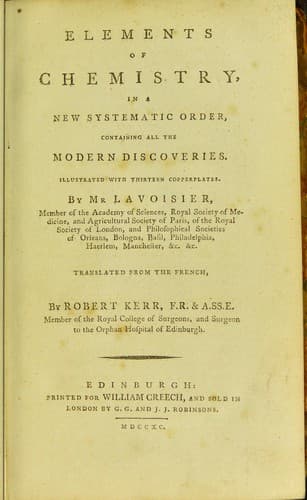
Elements of Chemistry,: In a New Systematic Order, Containing all the Modern DiscoveriesLavoisier, Antoine Laurent
Science
Elements of Chemistry,: In a New Systematic Order, Containing all the Modern Discoveries
Lavoisier, Antoine Laurent
Chemistry -- Early works to 1800
What I have already said may suffice to determine the idea affixed to
the word _caloric_; but there remains a more difficult attempt, which
is, to give a just conception of the manner in which caloric acts upon
other bodies. Since this subtile matter penetrates through the pores of
all known substances; since there are no vessels through which it cannot
escape, and, consequently, as there are none which are capable of
retaining it, we can only come at the knowledge of its properties by
effects which are fleeting, and difficultly ascertainable. It is in
these things which we neither see nor feel, that it is especially
necessary to guard against the extravagancy of our imagination, which
forever inclines to step beyond the bounds of truth, and is very
difficultly restrained within the narrow line of facts.
We have already seen, that the same body becomes solid, or fluid, or
aeriform, according to the quantity of caloric by which it is
penetrated; or, to speak more strictly, according as the repulsive force
exerted by the caloric is equal to, stronger, or weaker, than the
attraction of the particles of the body it acts upon.
But, if these two powers only existed, bodies would become liquid at an
indivisible degree of the thermometer, and would almost instantaneously
pass from the solid state of aggregation to that of aeriform elasticity.
Thus water, for instance, at the very moment when it ceases to be ice,
would begin to boil, and would be transformed into an aeriform fluid,
having its particles scattered indefinitely through the surrounding
space. That this does not happen, must depend upon the action of some
third power. The pressure of the atmosphere prevents this separation,
and causes the water to remain in the liquid state till it be raised to
80 deg. of temperature (212 deg.) above zero of the French thermometer,
the quantity of caloric which it receives in the lowest temperature being
insufficient to overcome the pressure of the atmosphere.
Whence it appears that, without this atmospheric pressure, we should not
have any permanent liquid, and should only be able to see bodies in that
state of existence in the very instant of melting, as the smallest
additional caloric would instantly separate their particles, and
dissipate them through the surrounding medium. Besides, without this
atmospheric pressure, we should not even have any aeriform fluids,
strictly speaking, because the moment the force of attraction is
overcome by the repulsive power of the caloric, the particles would
separate themselves indefinitely, having nothing to give limits to their
expansion, unless their own gravity might collect them together, so as
to form an atmosphere.
Simple reflection upon the most common experiments is sufficient to
evince the truth of these positions. They are more particularly proved
by the following experiment, which I published in the Memoirs of the
French Academy for 1777, p. 426.
Public-domain text, read in full here on John Shaqi.
Reviews
Reviews
No reviews yet
Be the first to share your thoughts on this work.
Join the Discussion
Join the discussion
Sign in to leave a comment or review.
Sign InorCreate an account