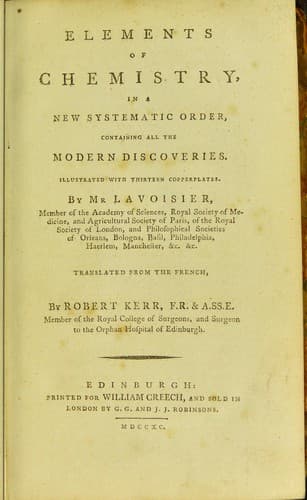
Elements of Chemistry,: In a New Systematic Order, Containing all the Modern DiscoveriesLavoisier, Antoine Laurent
Science
Elements of Chemistry,: In a New Systematic Order, Containing all the Modern Discoveries
Lavoisier, Antoine Laurent
Chemistry -- Early works to 1800
These are instruments of most universal use in chemistry; and, as the
success of a great number of experiments depends upon their being well
or ill constructed, it is of great importance that a laboratory be well
provided in this respect. A furnace is a kind of hollow cylindrical
tower, sometimes widened above, Pl. XIII. Fig. 1. ABCD, which must have
at least two lateral openings; one in its upper part F, which is the
door of the fire-place, and one below, G, leading to the ash-hole.
Between these the furnace is divided by a horizontal grate, intended
for supporting the fewel, the situation of which is marked in the figure
by the line HI. Though this be the least complicated of all the chemical
furnaces, yet it is applicable to a great number of purposes. By it
lead, tin, bismuth, and, in general, every substance which does not
require a very strong fire, may be melted in crucibles; it will serve
for metallic oxydations, for evaporatory vessels, and for sand-baths, as
in Pl. III. Fig. 1. and 2. To render it proper for these purposes,
several notches, m m m m, Pl. XIII. Fig. 1. are made in its upper
edge, as otherwise any pan which might be placed over the fire would
stop the passage of the air, and prevent the fewel from burning. This
furnace can only produce a moderate degree of heat, because the quantity
of charcoal it is capable of consuming is limited by the quantity of air
which is allowed to pass through the opening G of the ash-hole. Its
power might be considerably augmented by enlarging this opening, but
then the great stream of air which is convenient for some operations
might be hurtful in others; wherefore we must have furnaces of different
forms, constructed for different purposes, in our laboratories: There
ought especially to be several of the kind now described of different
sizes.
Public-domain text, read in full here on John Shaqi.
Reviews
Reviews
No reviews yet
Be the first to share your thoughts on this work.
Elsewhere in the archive
Join the Discussion
Join the discussion
Sign in to leave a comment or review.
Sign InorCreate an account