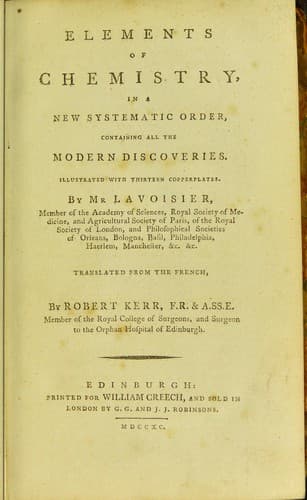
Elements of Chemistry,: In a New Systematic Order, Containing all the Modern DiscoveriesLavoisier, Antoine Laurent
Science
Elements of Chemistry,: In a New Systematic Order, Containing all the Modern Discoveries
Lavoisier, Antoine Laurent
Chemistry -- Early works to 1800
This operation is commonly performed in vessels called crucibles, which
must necessarily be less fusible than the bodies they are intended to
contain. Hence, in all ages, chemists have been extremely solicitous to
procure crucibles of very refractory materials, or such as are capable
of resisting a very high degree of heat. The best are made of very pure
clay or of porcelain earth; whereas such as are made of clay mixed with
calcareous or silicious earth are very fusible. All the crucibles made
in the neighbourhood of Paris are of this kind, and consequently unfit
for most chemical experiments. The Hessian crucibles are tolerably good;
but the best are made of Limoges earth, which seems absolutely
infusible. We have, in France, a great many clays very fit for making
crucibles; such, for instance, is the kind used for making melting pots
at the glass-manufactory of St Gobin.
Crucibles are made of various forms, according to the operations they
are intended to perform. Several of the most common kinds are
represented Pl. VII. Fig. 7. 8. 9. and 10. the one represented at Fig.
9. is almost shut at its mouth.
Though fusion may often take place without changing the nature of the
fused body, this operation is frequently employed as a chemical means of
decomposing and recompounding bodies. In this way all the metals are
extracted from their ores; and, by this process, they are revivified,
moulded, and alloyed with each other. By this process sand and alkali
are combined to form glass, and by it likewise pastes, or coloured
stones, enamels, &c. are formed.
The action of violent fire was much more frequently employed by the
ancient chemists than it is in modern experiments. Since greater
precision has been employed in philosophical researches, the _humid_ has
been preferred to the _dry_ method of process, and fusion is seldom had
recourse to until all the other means of analysis have failed.
SECT. II.
_Of Furnaces._
Public-domain text, read in full here on John Shaqi.
Reviews
Reviews
No reviews yet
Be the first to share your thoughts on this work.
Elsewhere in the archive
Join the Discussion
Join the discussion
Sign in to leave a comment or review.
Sign InorCreate an account