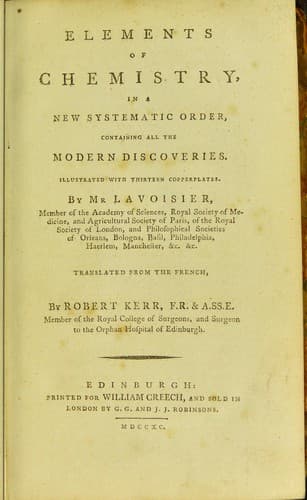
Elements of Chemistry,: In a New Systematic Order, Containing all the Modern DiscoveriesLavoisier, Antoine Laurent
Science
Elements of Chemistry,: In a New Systematic Order, Containing all the Modern Discoveries
Lavoisier, Antoine Laurent
Chemistry -- Early works to 1800
The air circulates in a furnace in consequence of being heated in its
passage through the burning coals; it dilates, and, becoming lighter
than the surrounding air, is forced to rise upwards by the pressure of
the lateral columns of air, and is replaced by fresh air from all sides,
especially from below. This circulation of air even takes place when
coals are burnt in a common chaffing dish; but we can readily conceive,
that, in a furnace open on all sides, the mass of air which passes, all
other circumstances being equal, cannot be so great as when it is
obliged to pass through a furnace in the shape of a hollow tower, like
most of the chemical furnaces, and consequently, that the combustion
must be more rapid in a furnace of this latter construction. Suppose,
for instance, the furnace ABCDEF open above, and filled with burning
coals, the force with which the air passes through the coals will be in
proportion to the difference between the specific gravity of two columns
equal to AC, the one of cold air without, and the other of heated air
within the furnace. There must be some heated air above the opening AB,
and the superior levity of this ought likewise to be taken into
consideration; but, as this portion is continually coolled and carried
off by the external air, it cannot produce any great effect.
But, if we add to this furnace a large hollow tube GHAB of the same
diameter, which preserves the air which has been heated by the burning
coals from being coolled and dispersed by the surrounding air, the
difference of specific gravity which causes the circulation will then be
between two columns equal to GC. Hence, if GC be three times the length
of AC, the circulation will have treble force. This is upon the
supposition that the air in GHCD is as much heated as what is contained
in ABCD, which is not strictly the case, because the heat must decrease
between AB and GH; but, as the air in GHAB is much warmer than the
external air, it follows, that the addition of the tube must increase
the rapidity of the stream of air, that a larger quantity must pass
through the coals, and consequently that a greater degree of combustion
must take place.
Public-domain text, read in full here on John Shaqi.
Reviews
Reviews
No reviews yet
Be the first to share your thoughts on this work.
Elsewhere in the archive
Join the Discussion
Join the discussion
Sign in to leave a comment or review.
Sign InorCreate an account