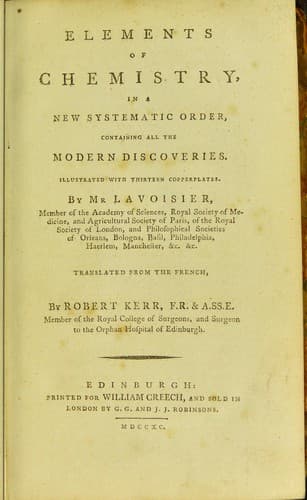
Elements of Chemistry,: In a New Systematic Order, Containing all the Modern DiscoveriesLavoisier, Antoine Laurent
Science
Elements of Chemistry,: In a New Systematic Order, Containing all the Modern Discoveries
Lavoisier, Antoine Laurent
Chemistry -- Early works to 1800
We must not, however, conclude from these principles, that the length of
this tube ought to be indefinitely prolonged; for, since the heat of the
air gradually diminishes in passing from AB to GH, even from the contact
of the sides of the tube, if the tube were prolonged to a certain
degree, we would at last come to a point where the specific gravity of
the included air would be equal to the air without; and, in this case,
as the cool air would no longer tend to rise upwards, it would become a
gravitating mass, resisting the ascension of the air below. Besides, as
this air, which has served for combustion, is necessarily mixed with
carbonic acid gas, which is considerably heavier than common air, if the
tube were made long enough, the air might at last approach so near to
the temperature of the external air as even to gravitate downwards;
hence we must conclude, that the length of the tube added to a furnace
must have some limit beyond which it weakens, instead of strengthening
the force of the fire.
From these reflections it follows, that the first foot of tube added to
a furnace produces more effect than the sixth, and the sixth more than
the tenth; but we have no data to ascertain at what height we ought to
stop. This limit of useful addition is so much the farther in proportion
as the materials of the tube are weaker conductors of heat, because the
air will thereby be so much less coolled; hence baked earth is much to
be preferred to plate iron. It would be even of consequence to make the
tube double, and to fill the interval with rammed charcoal, which is one
of the worst conductors of heat known; by this the refrigeration of the
air will be retarded, and the rapidity of the stream of air consequently
increased; and, by this means, the tube may be made so much the longer.
As the fire-place is the hottest part of a furnace, and the part where
the air is most dilated in its passage, this part ought to be made with
a considerable widening or belly. This is the more necessary, as it is
intended to contain the charcoal and crucible, as well as for the
passage of the air which supports, or rather produces the combustion;
hence we only allow the interstices between the coals for the passage of
the air.
From these principles my melting furnace is constructed, which I believe
is at least equal in power to any hitherto made, though I by no means
pretend that it possesses the greatest possible intensity that can be
produced in chemical furnaces. The augmentation of the volume of air
produced during its passage through a melting furnace not being hitherto
ascertained from experiment, we are still unacquainted with the
proportions which should exist between the inferior and superior
apertures, and the absolute size of which these openings should be made
is still less understood; hence data are wanting by which to proceed
upon principle, and we can only accomplish the end in view by repeated
trials.
Public-domain text, read in full here on John Shaqi.
Reviews
Reviews
No reviews yet
Be the first to share your thoughts on this work.
Elsewhere in the archive
Join the Discussion
Join the discussion
Sign in to leave a comment or review.
Sign InorCreate an account