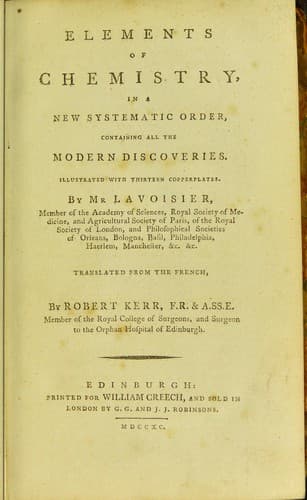
Elements of Chemistry,: In a New Systematic Order, Containing all the Modern DiscoveriesLavoisier, Antoine Laurent
Science
Elements of Chemistry,: In a New Systematic Order, Containing all the Modern Discoveries
Lavoisier, Antoine Laurent
Chemistry -- Early works to 1800
This furnace, which, according to the above stated rules, is in form of
an eliptical spheroid, is represented Pl. XIII. Fig. 6. ABCD; it is cut
off at the two ends by two plains, which pass, perpendicular to the
axis, through the foci of the elipse. From this shape it is capable of
containing a considerable quantity of charcoal, while it leaves
sufficient space in the intervals for the passage of the air. That no
obstacle may oppose the free access of external air, it is perfectly
open below, after the model of Mr Macquer's melting furnace, and stands
upon an iron tripod. The grate is made of flat bars set on edge, and
with considerable interstices. To the upper part is added a chimney, or
tube, of baked earth, ABFG, about eighteen feet long, and almost half
the diameter of the furnace. Though this furnace produces a greater heat
than any hitherto employed by chemists, it is still susceptible of being
considerably increased in power by the means already mentioned, the
principal of which is to render the tube as bad a conductor of heat as
possible, by making it double, and filling the interval with rammed
charcoal.
When it is required to know if lead contains any mixture of gold or
silver, it is heated in a strong fire in capsules of calcined bones,
which are called cuppels. The lead is oxydated, becomes vitrified, and
sinks into the substance of the cuppel, while the gold or silver, being
incapable of oxydation, remain pure. As lead will not oxydate without
free access of air, this operation cannot be performed in a crucible
placed in the middle of the burning coals of a furnace, because the
internal air, being mostly already reduced by the combustion into azotic
and carbonic acid gas, is no longer fit for the oxydation of metals. It
was therefore necessary to contrive a particular apparatus, in which the
metal should be at the same time exposed to the influence of violent
heat, and defended from contact with air rendered incombustible by its
passage through burning coals. The furnace intended for answering this
double purpose is called the cuppelling or essay furnace. It is usually
made of a square form, as represented Pl. XIII. Fig. 8. and 10. having
an ash-hole AABB, a fire-place BBCC, a laboratory CCDD, and a dome DDEE.
The muffle or small oven of baked earth GH, Fig. 9. being placed in the
laboratory of the furnace upon cross bars of iron, is adjusted to the
opening GG, and luted with clay softened in water. The cuppels are
placed in this oven or muffle, and charcoal is conveyed into the furnace
through the openings of the dome and fire-place. The external air enters
through the openings of the ash-hole for supporting the combustion, and
escapes by the superior opening or chimney at EE; and air is admitted
through the door of the muffle GG for oxydating the contained metal.
Public-domain text, read in full here on John Shaqi.
Reviews
Reviews
No reviews yet
Be the first to share your thoughts on this work.
Elsewhere in the archive
Join the Discussion
Join the discussion
Sign in to leave a comment or review.
Sign InorCreate an account