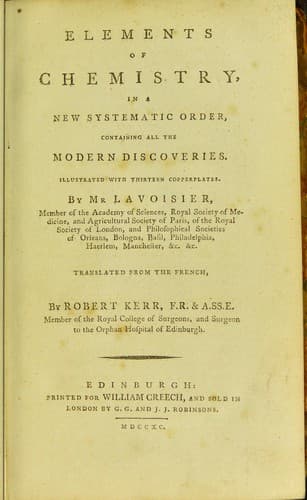
Elements of Chemistry,: In a New Systematic Order, Containing all the Modern DiscoveriesLavoisier, Antoine Laurent
Science
Elements of Chemistry,: In a New Systematic Order, Containing all the Modern Discoveries
Lavoisier, Antoine Laurent
Chemistry -- Early works to 1800
In reflecting upon the circumstances of this experiment, we readily
perceive, that the mercury, during its calcination, absorbs the
salubrious and respirable part of the air, or, to speak more strictly,
the base of this respirable part; that the remaining air is a species of
mephitis, incapable of supporting combustion or respiration; and
consequently that atmospheric air is composed of two elastic fluids of
different and opposite qualities. As a proof of this important truth, if
we recombine these two elastic fluids, which we have separately obtained
in the above experiment, viz. the 42 cubical inches of mephitis, with
the 8 cubical inches of respirable air, we reproduce an air precisely
similar to that of the atmosphere, and possessing nearly the same power
of supporting combustion and respiration, and of contributing to the
calcination of metals.
Although this experiment furnishes us with a very simple means of
obtaining the two principal elastic fluids which compose our atmosphere,
separate from each other, yet it does not give us an exact idea of the
proportion in which these two enter into its composition: For the
attraction of mercury to the respirable part of the air, or rather to
its base, is not sufficiently strong to overcome all the circumstances
which oppose this union. These obstacles are the mutual adhesion of the
two constituent parts of the atmosphere for each other, and the elective
attraction which unites the base of vital air with caloric; in
consequence of these, when the calcination ends, or is at least carried
as far as is possible, in a determinate quantity of atmospheric air,
there still remains a portion of respirable air united to the mephitis,
which the mercury cannot separate. I shall afterwards show, that, at
least in our climate, the atmospheric air is composed of respirable and
mephitic airs, in the proportion of 27 and 73; and I shall then discuss
the causes of the uncertainty which still exists with respect to the
exactness of that proportion.
Public-domain text, read in full here on John Shaqi.
Reviews
Reviews
No reviews yet
Be the first to share your thoughts on this work.
Join the Discussion
Join the discussion
Sign in to leave a comment or review.
Sign InorCreate an account