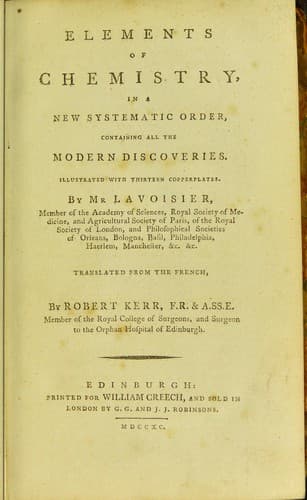
Elements of Chemistry,: In a New Systematic Order, Containing all the Modern DiscoveriesLavoisier, Antoine Laurent
Science
Elements of Chemistry,: In a New Systematic Order, Containing all the Modern Discoveries
Lavoisier, Antoine Laurent
Chemistry -- Early works to 1800
Since, during the calcination of mercury, air is decomposed, and the
base of its respirable part is fixed and combined with the mercury, it
follows, from the principles already established, that caloric and light
must be disengaged during the process: But the two following causes
prevent us from being sensible of this taking place: As the calcination
lasts during several days, the disengagement of caloric and light,
spread out in a considerable space of time, becomes extremely small for
each particular moment of that time, so as not to be perceptible; and,
in the next place, the operation being carried on by means of fire in a
furnace, the heat produced by the calcination itself becomes confounded
with that proceeding from the furnace. I might add the respirable part
of the air, or rather its base, in entering into combination with the
mercury, does not part with all the caloric which it contained, but
still retains a part of it after forming the new compound; but the
discussion of this point, and its proofs from experiment, do not belong
to this part of our subject.
It is, however, easy to render this disengagement of caloric and light
evident to the senses, by causing the decomposition of air to take place
in a more rapid manner. And for this purpose, iron is excellently
adapted, as it possesses a much stronger affinity for the base of
respirable air than mercury. The elegant experiment of Mr Ingenhouz,
upon the combustion of iron, is well known. Take a piece of fine iron
wire, twisted into a spiral, (BC, Plate IV. Fig. 17.) fix one of its
extremities B into the cork A, adapted to the neck of the bottle DEFG,
and fix to the other extremity of the wire C, a small morsel of tinder.
Matters being thus prepared, fill the bottle DEFG with air deprived of
its mephitic part; then light the tinder, and introduce it quickly with
the wire upon which it is fixed, into the bottle which you stop up with
the cork A, as is shown in the figure (17 Plate IV.) The instant the
tinder comes into contact with the vital air it begins to burn with
great intensity; and, communicating the inflammation to the iron-wire,
it too takes fire, and burns rapidly, throwing out brilliant sparks,
which fall to the bottom of the vessel in rounded globules, which become
black in cooling, but retain a degree of metallic splendour. The iron
thus burnt is more brittle even than glass, and is easily reduced into
powder, and is still attractable by the magnet, though not so powerfully
as it was before combustion. As Mr Ingenhouz has neither examined the
change produced on iron, nor upon the air by this operation, I have
repeated the experiment under different circumstances, in an apparatus
adapted to answer my particular views, as follows.
Public-domain text, read in full here on John Shaqi.
Reviews
Reviews
No reviews yet
Be the first to share your thoughts on this work.
Join the Discussion
Join the discussion
Sign in to leave a comment or review.
Sign InorCreate an account