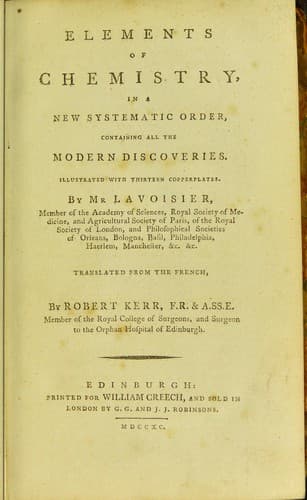
Elements of Chemistry,: In a New Systematic Order, Containing all the Modern DiscoveriesLavoisier, Antoine Laurent
Science
Elements of Chemistry,: In a New Systematic Order, Containing all the Modern Discoveries
Lavoisier, Antoine Laurent
Chemistry -- Early works to 1800
Having filled a bell-glass (A, Plate IV. Fig. 3.) of about six pints
measure, with pure air, or the highly respirable part of air, I
transported this jar by means of a very flat vessel, into a quicksilver
bath in the bason BC, and I took care to render the surface of the
mercury perfectly dry both within and without the jar with blotting
paper. I then provided a small capsule of china-ware D, very flat and
open, in which I placed some small pieces of iron, turned spirally, and
arranged in such a way as seemed most favourable for the combustion
being communicated to every part. To the end of one of these pieces of
iron was fixed a small morsel of tinder, to which was added about the
sixteenth part of a grain of phosphorus, and, by raising the bell-glass
a little, the china capsule, with its contents, were introduced into the
pure air. I know that, by this means, some common air must mix with the
pure air in the glass; but this, when it is done dexterously, is so very
trifling, as not to injure the success of the experiment. This being
done, a part of the air is sucked out from the bell-glass, by means of a
syphon GHI, so as to raise the mercury within the glass to EF; and, to
prevent the mercury from getting into the syphon, a small piece of paper
is twisted round its extremity. In sucking out the air, if the motion of
the lungs only be used, we cannot make the mercury rise above an inch or
an inch and a half; but, by properly using the muscles of the mouth, we
can, without difficulty, cause it to rise six or seven inches.
I next took an iron wire, (MN, Plate IV. Fig. 16.) properly bent for the
purpose, and making it red hot in the fire, passed it through the
mercury into the receiver, and brought it in contact with the small
piece of phosphorus attached to the tinder. The phosphorus instantly
takes fire, which communicates to the tinder, and from that to the iron.
When the pieces have been properly arranged, the whole iron burns, even
to the last particle, throwing out a white brilliant light similar to
that of Chinese fireworks. The great heat produced by this combustion
melts the iron into round globules of different sizes, most of which
fall into the China cup; but some are thrown out of it, and swim upon
the surface of the mercury. At the beginning of the combustion, there is
a slight augmentation in the volume of the air in the bell-glass, from
the dilatation caused by the heat; but, presently afterwards, a rapid
diminution of the air takes place, and the mercury rises in the glass;
insomuch that, when the quantity of iron is sufficient, and the air
operated upon is very pure, almost the whole air employed is absorbed.
Public-domain text, read in full here on John Shaqi.
Reviews
Reviews
No reviews yet
Be the first to share your thoughts on this work.
Join the Discussion
Join the discussion
Sign in to leave a comment or review.
Sign InorCreate an account