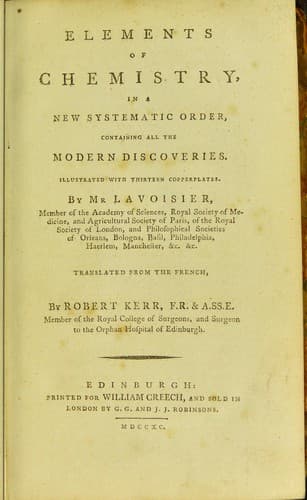
Elements of Chemistry,: In a New Systematic Order, Containing all the Modern DiscoveriesLavoisier, Antoine Laurent
Science
Elements of Chemistry,: In a New Systematic Order, Containing all the Modern Discoveries
Lavoisier, Antoine Laurent
Chemistry -- Early works to 1800
It is proper to remark in this place, that, unless in making experiments
for the purpose of discovery, it is better to be contented with burning
a moderate quantity of iron; for, when this experiment is pushed too
far, so as to absorb much of the air, the cup D, which floats upon the
quicksilver, approaches too near the bottom of the bell-glass; and the
great heat produced, which is followed by a very sudden cooling,
occasioned by the contact of the cold mercury, is apt to break the
glass. In which case, the sudden fall of the column of mercury, which
happens the moment the least flaw is produced in the glass, causes such
a wave, as throws a great part of the quicksilver from the bason. To
avoid this inconvenience, and to ensure success to the experiment, one
gross and a half of iron is sufficient to burn in a bell-glass, which
holds about eight pints of air. The glass ought likewise to be strong,
that it may be able to bear the weight of the column of mercury which it
has to support.
By this experiment, it is not possible to determine, at one time, both
the additional weight acquired by the iron, and the changes which have
taken place in the air. If it is wished to ascertain what additional
weight has been gained by the iron, and the proportion between that and
the air absorbed, we must carefully mark upon the bell-glass, with a
diamond, the height of the mercury, both before and after the
experiment[9]. After this, the syphon (GH, Pl. IV. fig. 3.) guarded, as
before, with a bit of paper, to prevent its filling with mercury, is to
be introduced under the bell-glass, having the thumb placed upon the
extremity, G, of the syphon, to regulate the passage of the air; and by
this means the air is gradually admitted, so as to let the mercury fall
to its level. This being done, the bell-glass is to be carefully
removed, the globules of melted iron contained in the cup, and those
which have been scattered about, and swim upon the mercury, are to be
accurately collected, and the whole is to be weighed. The iron will be
found in that state called _martial ethiops_ by the old chemists,
possessing a degree of metallic brilliancy, very friable, and readily
reducible into powder, under the hammer, or with a pestle and mortar. If
the experiment has succeeded well, from 100 grains of iron will be
obtained 135 or 136 grains of ethiops, which is an augmentation of 35
per cent.
If all the attention has been paid to this experiment which it deserves,
the air will be found diminished in weight exactly equal to what the
iron has gained. Having therefore burnt 100 grains of iron, which has
acquired an additional weight of 35 grains, the diminution of air will
be found exactly 70 cubical inches; and it will be found, in the sequel,
that the weight of vital air is pretty nearly half a grain for each
cubical inch; so that, in effect, the augmentation of weight in the one
exactly coincides with the loss of it in the other.
Public-domain text, read in full here on John Shaqi.
Reviews
Reviews
No reviews yet
Be the first to share your thoughts on this work.
Elsewhere in the archive
Join the Discussion
Join the discussion
Sign in to leave a comment or review.
Sign InorCreate an account