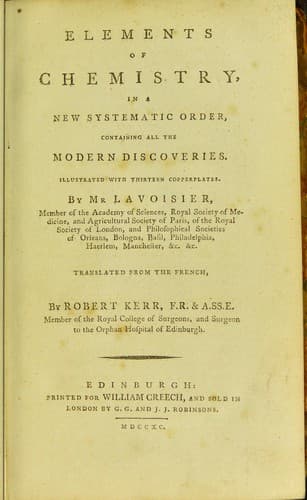
Elements of Chemistry,: In a New Systematic Order, Containing all the Modern DiscoveriesLavoisier, Antoine Laurent
Science
Elements of Chemistry,: In a New Systematic Order, Containing all the Modern Discoveries
Lavoisier, Antoine Laurent
Chemistry -- Early works to 1800
I shall observe here, once for all, that, in every experiment of this
kind, the pressure and temperature of the air, both before and after the
experiment, must be reduced, by calculation, to a common standard of 10
deg. (54.5 deg.) of the thermometer, and 28 inches of the barometer.
Towards the end of this work, the manner of performing this very
necessary reduction will be found accurately detailed.
If it be required to examine the nature of the air which remains after
this experiment, we must operate in a somewhat different manner. After
the combustion is finished, and the vessels have cooled, we first take
out the cup, and the burnt iron, by introducing the hand through the
quicksilver, under the bell-glass; we next introduce some solution of
potash, or caustic alkali, or of the sulphuret of potash, or such other
substance as is judged proper for examining their action upon the
residuum of air. I shall, in the sequel, give an account of these
methods of analysing air, when I have explained the nature of these
different substances, which are only here in a manner accidentally
mentioned. After this examination, so much water must be let into the
glass as will displace the quicksilver, and then, by means of a shallow
dish placed below the bell-glass, it is to be removed into the common
water pneumato-chemical apparatus, where the air remaining may be
examined at large, and with great facility.
When very soft and very pure iron has been employed in this experiment,
and, if the combustion has been performed in the purest respirable or
vital air, free from all admixture of the noxious or mephitic part, the
air which remains after the combustion will be found as pure as it was
before; but it is difficult to find iron entirely free from a small
portion of charry matter, which is chiefly abundant in steel. It is
likewise exceedingly difficult to procure the pure air perfectly free
from some admixture of mephitis, with which it is almost always
contaminated; but this species of noxious air does not, in the smallest
degree, disturb the result of the experiment, as it is always found at
the end exactly in the same proportion as at the beginning.
Public-domain text, read in full here on John Shaqi.
Reviews
Reviews
No reviews yet
Be the first to share your thoughts on this work.
Elsewhere in the archive
Join the Discussion
Join the discussion
Sign in to leave a comment or review.
Sign InorCreate an account