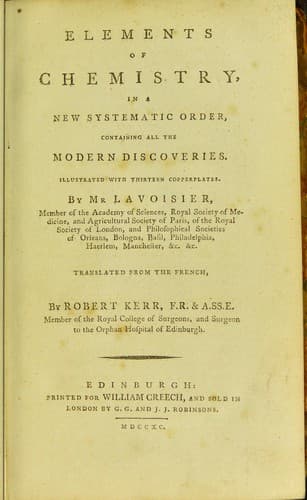
Elements of Chemistry,: In a New Systematic Order, Containing all the Modern DiscoveriesLavoisier, Antoine Laurent
Science
Elements of Chemistry,: In a New Systematic Order, Containing all the Modern Discoveries
Lavoisier, Antoine Laurent
Chemistry -- Early works to 1800
When all things were properly disposed, I set fire to the phosphorus
with a burning glass. The combustion was extremely rapid, accompanied
with a bright flame, and much heat; as the operation went on, large
quantities of white flakes attached themselves to the inner surface of
the baloon, so that at last it was rendered quite opake. The quantity
of these flakes at last became so abundant, that, although fresh oxygen
gas was continually supplied, which ought to have supported the
combustion, yet the phosphorus was soon extinguished. Having allowed the
apparatus to cool completely, I first ascertained the quantity of oxygen
gas employed, and weighed the baloon accurately, before it was opened. I
next washed, dried, and weighed the small quantity of phosphorus
remaining in the cup, on purpose to determine the whole quantity of
phosphorus consumed in the experiment; this residuum of the phosphorus
was of a yellow ochrey colour. It is evident, that by these several
precautions, I could easily determine, 1st, the weight of the phosphorus
consumed; 2d, the weight of the flakes produced by the combustion; and,
3d, the weight of the oxygen which had combined with the phosphorus.
This experiment gave very nearly the same results with the former, as it
proved that the phosphorus, during its combustion, had absorbed a little
more than one and a half its weight of oxygen; and I learned with more
certainty, that the weight of the new substance, produced in the
experiment, exactly equalled the sum of the weights of the phosphorus
consumed, and oxygen absorbed, which indeed was easily determinable _a
priori_. If the oxygen gas employed be pure, the residuum after
combustion is as pure as the gas employed; this proves that nothing
escapes from the phosphorus, capable of altering the purity of the
oxygen gas, and that the only action of the phosphorus is to separate
the oxygen from the caloric, with which it was before united.
I mentioned above, that when any combustible body is burnt in a hollow
sphere of ice, or in an apparatus properly constructed upon that
principle, the quantity of ice melted during the combustion is an exact
measure of the quantity of caloric disengaged. Upon this head, the
memoir given by M. de la Place and me, A(masculine ordinal). 1780, p. 355,
may be consulted. Having submitted the combustion of phosphorus to this
trial, we found that one pound of phosphorus melted a little more than
100 pounds of ice during its combustion.
The combustion of phosphorus succeeds equally well in atmospheric air as
in oxygen gas, with this difference, that the combustion is vastly
slower, being retarded by the large proportion of azotic gas mixed with
the oxygen gas, and that only about one-fifth part of the air employed
is absorbed, because as the oxygen gas only is absorbed, the proportion
of the azotic gas becomes so great toward the close of the experiment,
as to put an end to the combustion.
Public-domain text, read in full here on John Shaqi.
Reviews
Reviews
No reviews yet
Be the first to share your thoughts on this work.
Elsewhere in the archive
Join the Discussion
Join the discussion
Sign in to leave a comment or review.
Sign InorCreate an account