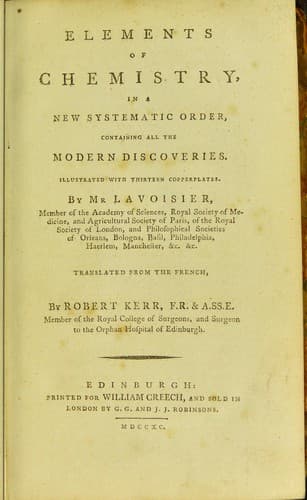
Elements of Chemistry,: In a New Systematic Order, Containing all the Modern DiscoveriesLavoisier, Antoine Laurent
Science
Elements of Chemistry,: In a New Systematic Order, Containing all the Modern Discoveries
Lavoisier, Antoine Laurent
Chemistry -- Early works to 1800
I have already shown, that phosphorus is changed by combustion into an
extremely light, white, flakey matter; and its properties are entirely
altered by this transformation: From being insoluble in water, it
becomes not only soluble, but so greedy of moisture, as to attract the
humidity of the air with astonishing rapidity; by this means it is
converted into a liquid, considerably more dense, and of more specific
gravity than water. In the state of phosphorus before combustion, it had
scarcely any sensible taste, by its union with oxygen it acquires an
extremely sharp and sour taste: in a word, from one of the class of
combustible bodies, it is changed into an incombustible substance, and
becomes one of those bodies called acids.
This property of a combustible substance to be converted into an acid,
by the addition of oxygen, we shall presently find belongs to a great
number of bodies: Wherefore, strict logic requires that we should adopt
a common term for indicating all these operations which produce
analogous results; this is the true way to simplify the study of
science, as it would be quite impossible to bear all its specifical
details in the memory, if they were not classically arranged. For this
reason, we shall distinguish this conversion of phosphorus into an acid,
by its union with oxygen, and in general every combination of oxygen
with a combustible substance, by the term of _oxygenation_: from which
I shall adopt the verb to _oxygenate_, and of consequence shall say,
that in _oxygenating_ phosphorus we convert it into an acid.
Sulphur is likewise a combustible body, or, in other words, it is a body
which possesses the power of decomposing oxygen gas, by attracting the
oxygen from the caloric with which it was combined. This can very easily
be proved, by means of experiments quite similar to those we have given
with phosphorus; but it is necessary to premise, that in these
operations with sulphur, the same accuracy of result is not to be
expected as with phosphorus; because the acid which is formed by the
combustion of sulphur is difficultly condensible, and because sulphur
burns with more difficulty, and is soluble in the different gasses. But
I can safely assert, from my own experiments, that sulphur in burning
absorbs oxygen gas; that the resulting acid is considerably heavier than
the sulphur burnt; that its weight is equal to the sum of the weights of
the sulphur which has been burnt, and of the oxygen absorbed; and,
lastly that this acid is weighty, incombustible, and miscible with water
in all proportions: The only uncertainty remaining upon this head, is
with regard to the proportions of sulphur and of oxygen which enter into
the composition of the acid.
Public-domain text, read in full here on John Shaqi.
Reviews
Reviews
No reviews yet
Be the first to share your thoughts on this work.
Elsewhere in the archive
Join the Discussion
Join the discussion
Sign in to leave a comment or review.
Sign InorCreate an account