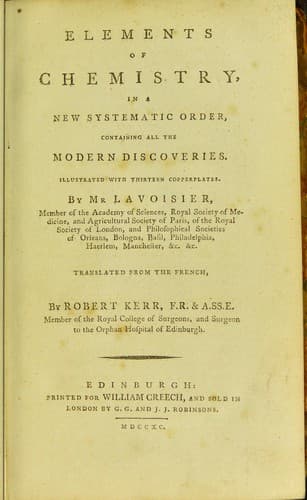
Elements of Chemistry,: In a New Systematic Order, Containing all the Modern DiscoveriesLavoisier, Antoine Laurent
Science
Elements of Chemistry,: In a New Systematic Order, Containing all the Modern Discoveries
Lavoisier, Antoine Laurent
Chemistry -- Early works to 1800
Charcoal, which, from all our present knowledge regarding it, must be
considered as a simple combustible body, has likewise the property of
decomposing oxygen gas, by absorbing its base from the caloric: But the
acid resulting from this combustion does not condense in the common
temperature; under the pressure of our atmosphere, it remains in the
state of gas, and requires a large proportion of water to combine with
or be dissolved in. This acid has, however, all the known properties of
other acids, though in a weaker degree, and combines, like them, with
all the bases which are susceptible of forming neutral salts.
The combustion of charcoal in oxygen gas, may be effected like that of
phosphorus in the bell-glass, (A. Pl. IV. fig. 3.) placed over mercury:
but, as the heat of red hot iron is not sufficient to set fire to the
charcoal, we must add a small morsel of tinder, with a minute particle
of phosphorus, in the same manner as directed in the experiment for the
combustion of iron. A detailed account of this experiment will be found
in the memoirs of the academy for 1781, p. 448. By that experiment it
appears, that 28 parts by weight of charcoal require 72 parts of oxygen
for saturation, and that the aeriform acid produced is precisely equal
in weight to the sum of the weights of the charcoal and oxygen gas
employed. This aeriform acid was called fixed or fixable air by the
chemists who first discovered it; they did not then know whether it was
air resembling that of the atmosphere, or some other elastic fluid,
vitiated and corrupted by combustion; but since it is now ascertained to
be an acid, formed like all others by the oxygenation of its peculiar
base, it is obvious that the name of fixed air is quite ineligible[11].
By burning charcoal in the apparatus mentioned p. 60, Mr de la Place and
I found that one lib. of charcoal melted 96 libs. 6 oz. of ice;
that, during the combustion, 2 libs. 9 oz. 1 gros. 10 grs. of
oxygen were absorbed, and that 3 libs. 9 oz. 1 gros. 10 grs. of
acid gas were formed. This gas weighs 0.695 parts of a grain for each
cubical inch, in the common standard temperature and pressure mentioned
above, so that 34,242 cubical inches of acid gas are produced by the
combustion of one pound of charcoal.
Public-domain text, read in full here on John Shaqi.
Reviews
Reviews
No reviews yet
Be the first to share your thoughts on this work.
Elsewhere in the archive
Join the Discussion
Join the discussion
Sign in to leave a comment or review.
Sign InorCreate an account