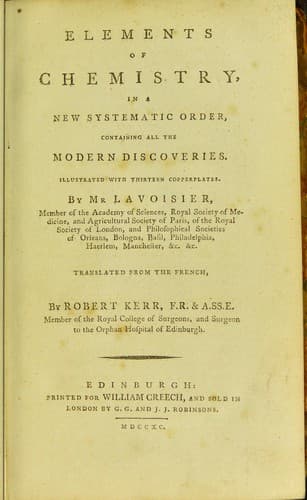
Elements of Chemistry,: In a New Systematic Order, Containing all the Modern DiscoveriesLavoisier, Antoine Laurent
Science
Elements of Chemistry,: In a New Systematic Order, Containing all the Modern Discoveries
Lavoisier, Antoine Laurent
Chemistry -- Early works to 1800
To disengage this acid from the alkaline base with which it is combined,
we have only to pour sulphuric acid upon sea-salt, immediately a brisk
effervescence takes place, white vapours arise, of a very penetrating
odour, and, by only gently heating the mixture, all the acid is driven
off. As, in the common temperature and pressure of our atmosphere, this
acid is naturally in the state of gas, we must use particular
precautions for retaining it in proper vessels. For small experiments,
the most simple and most commodious apparatus consists of a small retort
G, (Pl. V. Fig. 5.), into which the sea-salt is introduced, well
dried[13], we then pour on some concentrated sulphuric acid, and
immediately introduce the beak of the retort under little jars or
bell-glasses A, (same Plate and Fig.), previously filled with
quicksilver. In proportion as the acid gas is disengaged, it passes into
the jar, and gets to the top of the quicksilver, which it displaces.
When the disengagement of the gas slackens, a gentle heat is applied to
the retort, and gradually increased till nothing more passes over. This
acid gas has a very strong affinity with water, which absorbs an
enormous quantity of it, as is proved by introducing a very thin layer
of water into the glass which contains the gas; for, in an instant, the
whole acid gas disappears, and combines with the water.
This latter circumstance is taken advantage of in laboratories and
manufactures, on purpose to obtain the acid of sea-salt in a liquid
form; and for this purpose the apparatus (Pl. IV. Fig. 1.) is employed.
It consists, 1st, of a tubulated retort A, into which the sea-salt, and
after it the sulphuric acid, are introduced through the opening H; 2d,
of the baloon or recipient c, b, intended for containing the small
quantity of liquid which passes over during the process; and, 3d, of a
set of bottles, with two mouths, L, L, L, L, half filled with water,
intended for absorbing the gas disengaged by the distillation. This
apparatus will be more amply described in the latter part of this work.
Public-domain text, read in full here on John Shaqi.
Reviews
Reviews
No reviews yet
Be the first to share your thoughts on this work.
Elsewhere in the archive
Join the Discussion
Join the discussion
Sign in to leave a comment or review.
Sign InorCreate an account