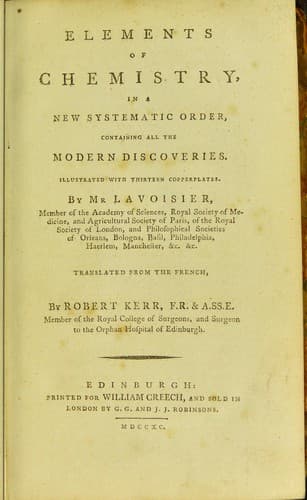
Elements of Chemistry,: In a New Systematic Order, Containing all the Modern DiscoveriesLavoisier, Antoine Laurent
Science
Elements of Chemistry,: In a New Systematic Order, Containing all the Modern Discoveries
Lavoisier, Antoine Laurent
Chemistry -- Early works to 1800
Although we have not yet been able, either to compose or to decompound
this acid of sea-salt, we cannot have the smallest doubt that it, like
all other acids, is composed by the union of oxygen with an acidifiable
base. We have therefore called this unknown substance the _muriatic
base_, or _muriatic radical_, deriving this name, after the example of
Mr Bergman and Mr de Morveau, from the Latin word _muria_, which was
anciently used to signify sea-salt. Thus, without being able exactly to
determine the component parts of _muriatic acid_, we design, by that
term, a volatile acid, which retains the form of gas in the common
temperature and pressure of our atmosphere, which combines with great
facility, and in great quantity, with water, and whose acidifiable base
adheres so very intimately with oxygen, that no method has hitherto been
devised for separating them. If ever this acidifiable base of the
muriatic acid is discovered to be a known substance, though now unknown
in that capacity, it will be requisite to change its present
denomination for one analogous with that of its base.
In common with sulphuric acid, and several other acids, the muriatic is
capable of different degrees of oxygenation; but the excess of oxygen
produces quite contrary effects upon it from what the same circumstance
produces upon the acid of sulphur. The lower degree of oxygenation
converts sulphur into a volatile gasseous acid, which only mixes in
small proportions with water, whilst a higher oxygenation forms an acid
possessing much stronger acid properties, which is very fixed and cannot
remain in the state of gas but in a very high temperature, which has no
smell, and which mixes in large proportion with water. With muriatic
acid, the direct reverse takes place; an additional saturation with
oxygen renders it more volatile, of a more penetrating odour, less
miscible with water, and diminishes its acid properties. We were at
first inclined to have denominated these two degrees of saturation in
the same manner as we had done with the acid of sulphur, calling the
less oxygenated _muriatous acid_, and that which is more saturated with
oxygen _muriatic acid_: But, as this latter gives very particular
results in its combinations, and as nothing analogous to it is yet known
in chemistry, we have left the name of muriatic acid to the less
saturated, and give the latter the more compounded appellation of
_oxygenated muriatic acid_.
Public-domain text, read in full here on John Shaqi.
Reviews
Reviews
No reviews yet
Be the first to share your thoughts on this work.
Elsewhere in the archive
Join the Discussion
Join the discussion
Sign in to leave a comment or review.
Sign InorCreate an account