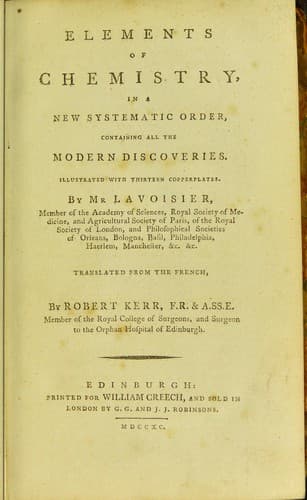
Elements of Chemistry,: In a New Systematic Order, Containing all the Modern DiscoveriesLavoisier, Antoine Laurent
Science
Elements of Chemistry,: In a New Systematic Order, Containing all the Modern Discoveries
Lavoisier, Antoine Laurent
Chemistry -- Early works to 1800
Although the base or radical of the acid which is extracted from nitre
or saltpetre be better known, we have judged proper only to modify its
name in the same manner with that of the muriatic acid. It is drawn from
nitre, by the intervention of sulphuric acid, by a process similar to
that described for extracting the muriatic acid, and by means of the
same apparatus (Pl. IV. Fig. 1.). In proportion as the acid passes over,
it is in part condensed in the baloon or recipient, and the rest is
absorbed by the water contained in the bottles L,L,L,L; the water
becomes first green, then blue, and at last yellow, in proportion to
the concentration of the acid. During this operation, a large quantity
of oxygen gas, mixed with a small proportion of azotic gas, is
disengaged.
This acid, like all others, is composed of oxygen, united to an
acidifiable base, and is even the first acid in which the existence of
oxygen was well ascertained. Its two constituent elements are but weakly
united, and are easily separated, by presenting any substance with which
oxygen has a stronger affinity than with the acidifiable base peculiar
to this acid. By some experiments of this kind, it was first discovered
that azote, or the base of mephitis or azotic gas, constituted its
acidifiable base or radical; and consequently that the acid of nitre was
really an azotic acid, having azote for its base, combined with oxygen.
For these reasons, that we might be consistent with our principles, it
appeared necessary, either to call the acid by the name of _azotic_, or
to name the base _nitric radical_; but from either of these we were
dissuaded, by the following considerations. In the _first_ place, it
seemed difficult to change the name of nitre or saltpetre, which has
been universally adopted in society, in manufactures, and in chemistry;
and, on the other hand, azote having been discovered by Mr Berthollet to
be the base of volatile alkali, or ammoniac, as well as of this acid,
we thought it improper to call it nitric radical. We have therefore
continued the term of azote to the base of that part of atmospheric air
which is likewise the nitric and ammoniacal radical; and we have named
the acid of nitre, in its lower and higher degrees of oxygenation,
_nitrous acid_ in the former, and _nitric acid_ in the latter state;
thus preserving its former appellation properly modified.
Several very respectable chemists have disapproved of this deference for
the old terms, and wished us to have persevered in perfecting a new
chemical language, without paying any respect for ancient usage; so
that, by thus steering a kind of middle course, we have exposed
ourselves to the censures of one sect of chemists, and to the
expostulations of the opposite party.
Public-domain text, read in full here on John Shaqi.
Reviews
Reviews
No reviews yet
Be the first to share your thoughts on this work.
Elsewhere in the archive
Join the Discussion
Join the discussion
Sign in to leave a comment or review.
Sign InorCreate an account