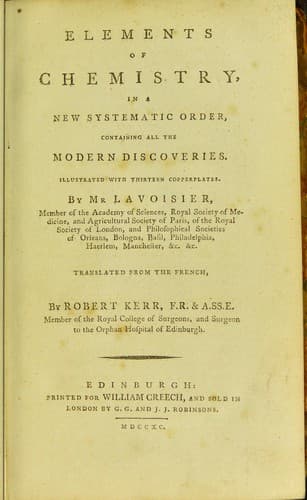
Elements of Chemistry,: In a New Systematic Order, Containing all the Modern DiscoveriesLavoisier, Antoine Laurent
Science
Elements of Chemistry,: In a New Systematic Order, Containing all the Modern Discoveries
Lavoisier, Antoine Laurent
Chemistry -- Early works to 1800
classifying substances of so very opposite natures, under the same
generic name, would have been quite contrary to our principles of
nomenclature, especially as, by retaining the above term for this state
of metallic substances, we must have conveyed very false ideas of its
nature. We have, therefore, laid aside the expression _metallic calx_
altogether, and have substituted in its place the term _oxyd_, from the
Greek word [Greek: oxys].
By this may be seen, that the language we have adopted is both copious
and expressive. The first or lowest degree of oxygenation in bodies,
converts them into _oxyds_; a second degree of additional oxygenation
constitutes the class of acids, of which the specific names, drawn from
their particular bases, terminate in _ous_, as the _nitrous_ and
_sulphurous_ acids; the third degree of oxygenation changes these into
the species of acids distinguished by the termination in ic, as the
_nitric_ and _sulphuric_ acids; and, lastly, we can express a fourth, or
highest degree of oxygenation, by adding the word _oxygenated_ to the
name of the acid, as has been already done with the _oxygenated
muriatic_ acid.
We have not confined the term _oxyd_ to expressing the combinations of
metals with oxygen, but have extended it to signify that first degree of
oxygenation in all bodies, which, without converting them into acids,
causes them to approach to the nature of salts. Thus, we give the name
of _oxyd of sulphur_ to that soft substance into which sulphur is
converted by incipient combustion; and we call the yellow matter left by
phosphorus, after combustion, by the name of _oxyd of phosphorus_. In
the same manner, nitrous gas, which is azote in its first degree of
oxygenation, is the _oxyd of azote_. We have likewise oxyds in great
numbers from the vegetable and animal kingdoms; and I shall show, in the
sequel, that this new language throws great light upon all the
operations of art and nature.
We have already observed, that almost all the metallic oxyds have
peculiar and permanent colours. These vary not only in the different
species of metals, but even according to the various degrees of
oxygenation in the same metal. Hence we are under the necessity of
adding two epithets to each oxyd, one of which indicates the metal
_oxydated_[15], while the other indicates the peculiar colour of the
oxyd. Thus, we have the black oxyd of iron, the red oxyd of iron, and
the yellow oxyd of iron; which expressions respectively answer to the
old unmeaning terms of martial ethiops, colcothar, and rust of iron, or
ochre. We have likewise the gray, yellow, and red oxyds of lead, which
answer to the equally false or insignificant terms, ashes of lead,
massicot, and minium.
Public-domain text, read in full here on John Shaqi.
Reviews
Reviews
No reviews yet
Be the first to share your thoughts on this work.
Elsewhere in the archive
Join the Discussion
Join the discussion
Sign in to leave a comment or review.
Sign InorCreate an account