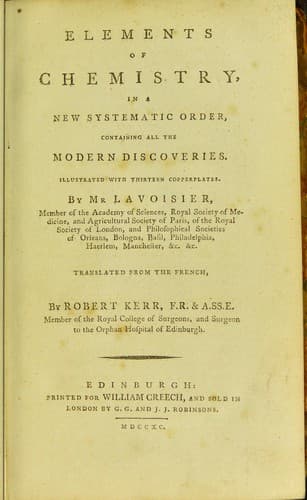
Elements of Chemistry,: In a New Systematic Order, Containing all the Modern DiscoveriesLavoisier, Antoine Laurent
Science
Elements of Chemistry,: In a New Systematic Order, Containing all the Modern Discoveries
Lavoisier, Antoine Laurent
Chemistry -- Early works to 1800
These denominations sometimes become rather long, especially when we
mean to indicate whether the metal has been oxydated in the air, by
detonation with nitre, or by means of acids; but then they always convey
just and accurate ideas of the corresponding object which we wish to
express by their use. All this will be rendered perfectly clear and
distinct by means of the tables which are added to this work.
FOOTNOTES:
[15] Here we see the word oxyd converted into the verb _to oxydate_,
_oxydated_, _oxydating_, after the same manner with the derivation of
the verb _to oxygenate_, _oxygenated_, _oxygenating_, from the word
_oxygen_. I am not clear of the absolute necessity of this second verb
here first introduced, but think, in a work of this nature, that it is
the duty of the translator to neglect every other consideration for the
sake of strict fidelity to the ideas of his author.--E.
CHAP. VIII.
_Of the Radical Principle of Water, and of its Decomposition by Charcoal
and Iron._
Until very lately, water has always been thought a simple substance,
insomuch that the older chemists considered it as an element. Such it
undoubtedly was to them, as they were unable to decompose it; or, at
least, since the decomposition which took place daily before their eyes
was entirely unnoticed. But we mean to prove, that water is by no means
a simple or elementary substance. I shall not here pretend to give the
history of this recent, and hitherto contested discovery, which is
detailed in the Memoirs of the Academy for 1781, but shall only bring
forwards the principal proofs of the decomposition and composition of
water; and, I may venture to say, that these will be convincing to such
as consider them impartially.
_Experiment First._
Having fixed the glass tube EF, (Pl. vii. fig. 11.) of from 8 to 12
lines diameter, across a furnace, with a small inclination from E to F,
lute the superior extremity E to the glass retort A, containing a
determinate quantity of distilled water, and to the inferior extremity
F, the worm SS fixed into the neck of the doubly tubulated bottle H,
which has the bent tube KK adapted to one of its openings, in such a
manner as to convey such aeriform fluids or gasses as may be disengaged,
during the experiment, into a proper apparatus for determining their
quantity and nature.
To render the success of this experiment certain, it is necessary that
the tube EF be made of well annealed and difficultly fusible glass, and
that it be coated with a lute composed of clay mixed with powdered
stone-ware; besides which, it must be supported about its middle by
means of an iron bar passed through the furnace, lest it should soften
and bend during the experiment. A tube of China-ware, or porcellain,
would answer better than one of glass for this experiment, were it not
difficult to procure one so entirely free from pores as to prevent the
passage of air or of vapours.
Public-domain text, read in full here on John Shaqi.
Reviews
Reviews
No reviews yet
Be the first to share your thoughts on this work.
Elsewhere in the archive
Join the Discussion
Join the discussion
Sign in to leave a comment or review.
Sign InorCreate an account