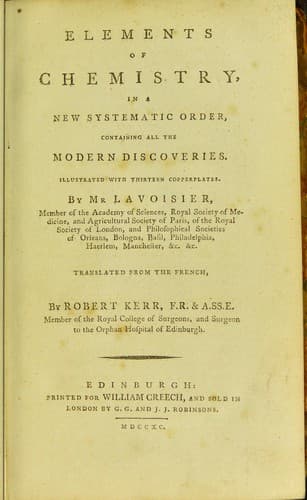
Elements of Chemistry,: In a New Systematic Order, Containing all the Modern DiscoveriesLavoisier, Antoine Laurent
Science
Elements of Chemistry,: In a New Systematic Order, Containing all the Modern Discoveries
Lavoisier, Antoine Laurent
Chemistry -- Early works to 1800
Thus water, besides the oxygen, which is one of its elements in common
with many other substances, contains another element as its constituent
base or radical, and for which we must find an appropriate term. None
that we could think of seemed better adapted than the word _hydrogen_,
which signifies the _generative principle of water_, from [Greek: ydor]
_aqua_, and [Greek: geinomas] _gignor_[17]. We call the combination of
this element with caloric _hydrogen gas_; and the term hydrogen
expresses the base of that gas, or the radical of water.
This experiment furnishes us with a new combustible body, or, in other
words, a body which has so much affinity with oxygen as to draw it from
its connection with caloric, and to decompose air or oxygen gas. This
combustible body has itself so great affinity with caloric, that, unless
when engaged in a combination with some other body, it always subsists
in the aeriform or gasseous state, in the usual temperature and pressure
of our atmosphere. In this state of gas it is about 1/13 of the weight
of an equal bulk of atmospheric air; it is not absorbed by water, though
it is capable of holding a small quantity of that fluid in solution, and
it is incapable of being used for respiration.
As the property this gas possesses, in common with all other combustible
bodies, is nothing more than the power of decomposing air, and carrying
off its oxygen from the caloric with which it was combined, it is easily
understood that it cannot burn, unless in contact with air or oxygen
gas. Hence, when we set fire to a bottle full of this gas, it burns
gently, first at the neck of the bottle, and then in the inside of it,
in proportion as the external air gets in: This combustion is slow and
successive, and only takes place at the surface of contact between the
two gasses. It is quite different when the two gasses are mixed before
they are set on fire: If, for instance, after having introduced one part
of oxygen gas into a narrow mouthed bottle, we fill it up with two
parts of hydrogen gas, and bring a lighted taper, or other burning body,
to the mouth of the bottle, the combustion of the two gasses takes place
instantaneously with a violent explosion. This experiment ought only to
be made in a bottle of very strong green glass, holding not more than a
pint, and wrapped round with twine, otherwise the operator will be
exposed to great danger from the rupture of the bottle, of which the
fragments will be thrown about with great force.
If all that has been related above, concerning the decomposition of
water, be exactly conformable to truth;--if, as I have endeavoured to
prove, that substance be really composed of hydrogen, as its proper
constituent element, combined with oxygen, it ought to follow, that, by
reuniting these two elements together, we should recompose water; and
that this actually happens may be judged of by the following experiment.
_Experiment Fourth._
Public-domain text, read in full here on John Shaqi.
Reviews
Reviews
No reviews yet
Be the first to share your thoughts on this work.
Elsewhere in the archive
Join the Discussion
Join the discussion
Sign in to leave a comment or review.
Sign InorCreate an account